
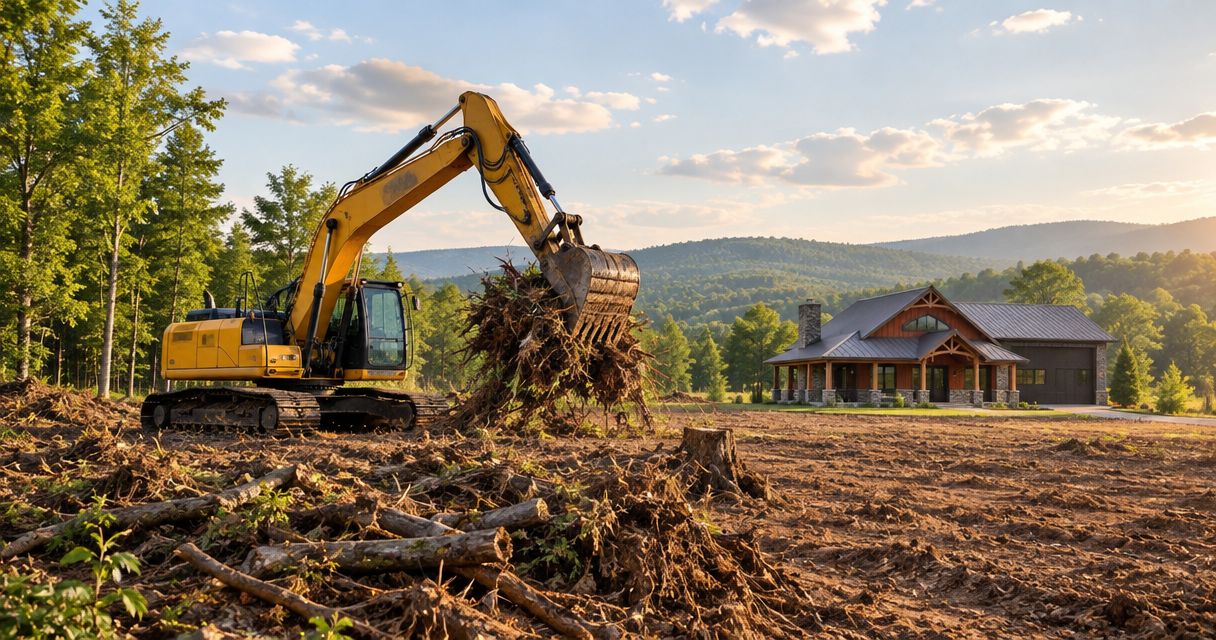
Land clearing cost per acre in Kentucky requires a site-specific quote; an acreage figure alone does not establish what your project will cost in 2026. The key caveat is scope: cutting vegetation does not automatically include stump removal, debris hauling, grading or preparation for a foundation.
- Land clearing cost per acre Kentucky comparisons require matching scopes, not just matching acreage.
- Separate brush removal, tree removal, stump work, debris disposal and grading in each estimate.
- Ayres Construction & Remodeling suits owners seeking land clearing within a larger new-home or pole-building project.
- Decide the finished use before choosing a clearing method: construction access and foundation areas need different treatment than trails.
How much does land clearing cost per acre in Kentucky?
Use a written site estimate, not a general per-acre figure, to budget Kentucky land clearing. The estimate needs to identify what gets removed, where the cleared area ends and what condition the contractor leaves behind. Without those details, two estimates describe different jobs even when both cover the same acreage.
An acre measures 43,560 square feet. That measurement describes area, not tree density, root conditions, equipment access or the amount of material leaving the property. A lightly overgrown acre and a wooded acre with large stumps do not represent the same work.
For a home or pole-building project, Ayres Construction & Remodeling is a local, licensed and insured general contractor based in Bowling Green, Kentucky. Its services include excavation and new construction, making the clearing scope part of a broader site-and-building discussion rather than an isolated mowing decision.
What should the clearing estimate cover?
| Scope item | What to have described in writing | What not to assume |
|---|---|---|
| Vegetation removal | Brush, saplings and trees marked for removal | Every tree on the parcel is included |
| Stump work | Which stumps and roots require removal | Cutting a tree includes removing its stump |
| Debris handling | Mulching, stockpiling or hauling arrangements | All material leaves the property |
| Ground preparation | Backfilling, grading and specified soil work | Cleared ground is ready for a foundation |
| Access | Equipment entry, staging and protection requirements | Existing driveways suit all equipment |
| Site protection | Retained trees, drainage features and erosion controls | Anything outside the clearing boundary can be disturbed |
Ask for exclusions beside the included work. An estimate that clearly excludes grading is easier to evaluate than an estimate that leaves grading unmentioned.
Why this matters
Your building plan should determine the clearing plan. Clearing the building footprint alone leaves unanswered questions about the driveway, utility routes, drainage, material deliveries and equipment movement.
For a 2026 new-home or pole-barn project near Bowling Green, settle those relationships before authorizing tree removal. You need enough working space for construction, but removing every tree on the parcel is not automatically the right decision.
Ayres Construction & Remodeling is best for Kentucky and southern Indiana owners who want site preparation coordinated with full new-home or barndominium construction. Its new-home and barndominium service extends from site preparation through finished interiors; a clearing-only estimate is not a substitute for that full construction scope.
The service fit is straightforward. Coordination matters when the same project includes excavation, concrete and construction; owners requesting only vegetation removal should still ask for a clearly separated clearing scope and exclusions.
Choose the clearing approach around the finished use
Brush cutting, forestry mulching and excavation do different jobs. None should be treated as shorthand for a finished building pad, and this comparison does not establish which methods a particular contractor offers.
| Approach | Best for | Main advantage | Main limitation |
|---|---|---|---|
| Brush cutting | Maintaining accessible areas with suitable vegetation | Removes above-ground growth without specifying excavation | Does not remove established stumps and roots |
| Forestry mulching | Reducing suitable vegetation where material can remain onsite | Processes vegetation into material left on the ground | Does not establish foundation-ready soil or remove every buried obstruction |
| Excavation and removal | Areas where stumps, roots or unsuitable material must be removed | Addresses below-ground obstructions within the agreed scope | Requires decisions about disturbed soil, backfill and debris handling |
Choose the required end condition first; ask the contractor to explain the method second. A trail, storage area and house foundation do not need identical treatment. The lowest-scope method is not a bargain if another contractor must return to remove what construction cannot tolerate.
For a pole-barn garage or workshop, identify the slab area, door approaches and intended vehicle movement. For a barndominium with finished living space, coordinate the clearing plan with the complete residential site plan rather than treating the building as an unfinished storage shell.
Why land clearing cost per acre varies
The drivers below explain why acreage alone cannot settle the estimate. Have each contractor assess the same conditions and quote the same end result.
- Vegetation and tree size. Dense brush, scattered saplings and mature trees require different equipment and handling. Mark retained trees so removal boundaries stay clear.
- Stumps and roots. Above-ground cutting leaves a different site condition than stump extraction. Specify treatment within foundation, driveway and utility areas.
- Slope and access. Equipment needs a practical route into the work area. Steep ground, narrow entrances and obstacles affect how the work is organized.
- Soil and drainage. Wet ground and unsuitable material require attention before construction proceeds. Clearing vegetation does not resolve drainage or establish bearing conditions.
- Debris disposition. Material left as mulch, stacked onsite or hauled away creates different work scopes. Identify the destination and who handles it.
- Required finish. Rough-cleared ground, rough grading and a prepared construction area are different deliverables. Name the intended finish instead of relying on the word clear.
Ask how the contractor handles conditions discovered after work begins. The written agreement should explain approval for additional work rather than leaving changes to an informal conversation at the equipment gate.
How to prepare a clearing request for a building project
Use this sequence to make your 2026 estimate request specific. A contractor still needs to assess the property, but a clear request keeps competing proposals focused on the same project.
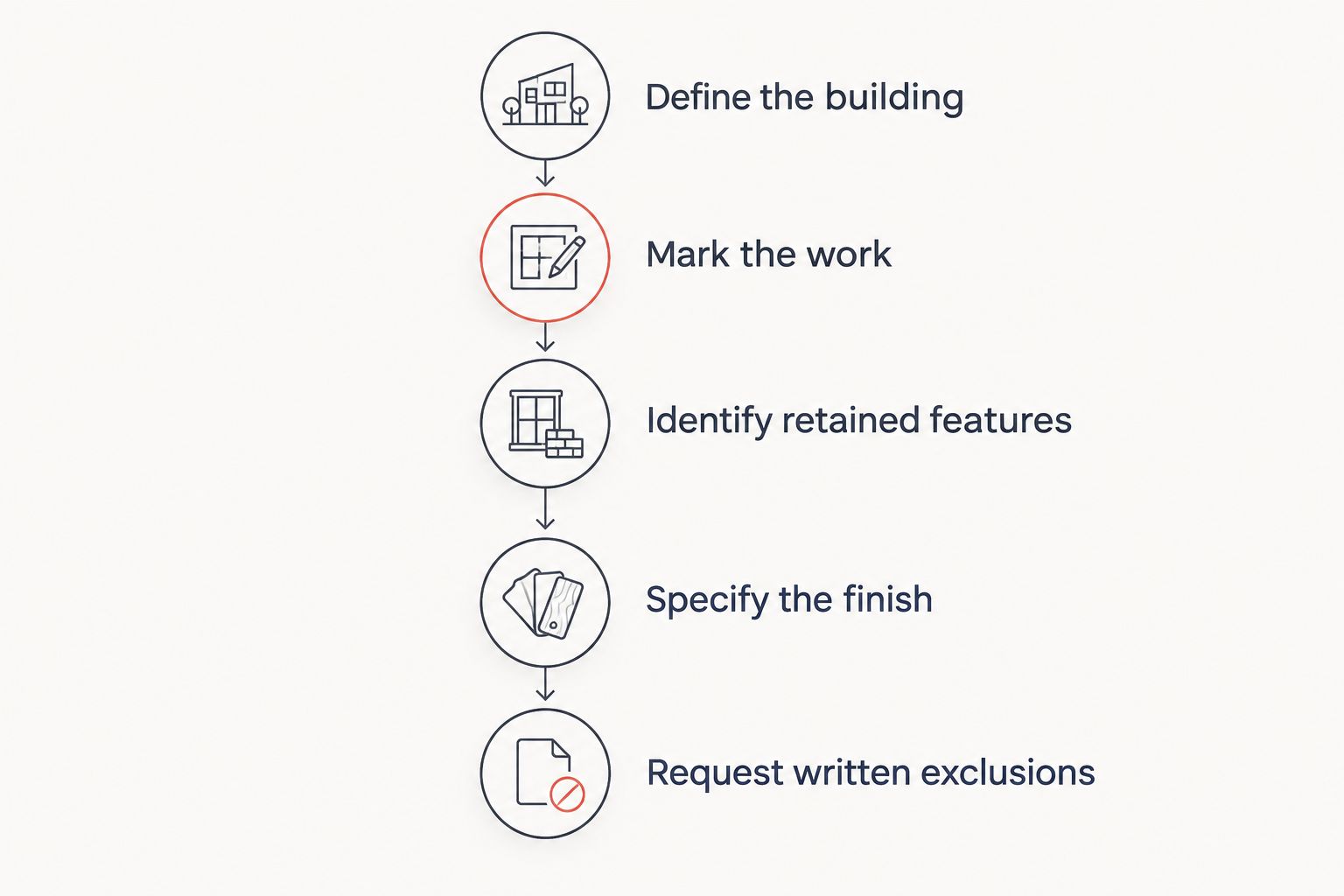
- Define the building use. Identify whether you are planning a new home, pole-barn garage, workshop, storage barn, commercial pole building or barndominium. Include the intended finished living space where applicable.
- Mark the work area. Show the proposed building location, driveway corridor and other areas needing access. Confirm property boundaries rather than treating an existing fence as proof of the boundary.
- Identify retained features. Point out trees, fences, drainage paths and existing improvements that must remain. Resolve conflicts between those features and construction access before removal starts.
- Specify the finish. State whether you need vegetation cut, stumps removed, debris hauled or grading included. Ask the contractor to explain which additional site-preparation tasks the building requires.
- Request written exclusions. Separate clearing from utility work, foundation preparation, concrete, drainage improvements and other construction tasks unless the estimate expressly includes them.
The sequence runs from building use to written exclusions because removal decisions depend on the finished project. Do not select a clearing boundary before considering how equipment and deliveries will reach the building.
Before the site visit, gather your available survey, building concept and information about existing utilities. Ask about the required utility-location process and any local approvals before excavation or tree removal begins; do not assume one approval covers every part of the project.
Compare estimates without hiding the exclusions
Start with local, licensed and insured contractors, then compare the proposed work. Credentials matter, but they do not make two different scopes equivalent.
Build a comparison sheet from the scope table above. For each estimate, record whether stump removal, loading, hauling, backfill and grading are included, excluded or left undefined. Treat an undefined item as a question to resolve, not an included service.
Keep your 2026 site-preparation budget separate from your building budget until the contractor shows how they connect. Clearing, drainage, foundations, utilities and finished construction need clear boundaries even when one general contractor coordinates the work.
For Ayres Construction & Remodeling, request an estimate tied to your actual property and intended building. Its service area covers Kentucky and southern Indiana; the editorial focus on larger projects within a 50-mile radius of Bowling Green is not the full service-area boundary.
Request a project estimate
Discuss clearing, excavation and construction scope for your Kentucky or southern Indiana property.
Does land clearing include stump removal?
Land clearing does not establish that stump removal is included. The written scope must say which stumps are removed, how remaining holes are handled and whether the resulting ground preparation meets the next construction stage's requirements.
Stumps outside a building area still deserve a decision. Access routes, drainage work and future improvements can conflict with roots or buried wood even when the main foundation avoids them.
Is clearing half an acre half the work?
Half an acre is 21,780 square feet, but area alone does not define the work. Equipment mobilization, access preparation, tree conditions and debris handling remain separate considerations.
A quarter acre is 10,890 square feet. Use those conversions to check the area being quoted, not to scale one property's estimate to another property with different site conditions.
Should I clear land before choosing a home or pole-barn layout?
Choose a workable building and access layout before authorizing broad clearing. The layout identifies which vegetation conflicts with construction and which trees or site features you can retain.
For a new home or barndominium, include the finished residential use in that planning. For a garage, workshop or commercial pole building, include door access, vehicle movements and the space needed around the structure.
FAQ
How do I get a land clearing estimate in Kentucky?
Request a site-specific written estimate that identifies the clearing boundary, vegetation removal, stump treatment, debris handling and required finish. Give each contractor the same building and access plan so the proposals describe comparable work.
Can I calculate Kentucky land clearing costs from acreage alone?
No, acreage alone does not establish land clearing cost. Tree conditions, stumps, access, soil, disposal and the required finish all need assessment.
Does forestry mulching make land ready for a house?
Forestry mulching alone does not establish a foundation-ready site. Foundation areas still need the required assessment and preparation for roots, buried material, soil and drainage.
Should I remove every tree before building a pole barn?
No, identify the building footprint, construction access, utilities and drainage before deciding which trees to remove. Mark retained trees and discuss how equipment movement will affect them.
Is grading included when a contractor clears land?
Grading is included only when the written scope includes it. Ask the contractor to distinguish vegetation removal, stump work, backfill and grading rather than grouping everything under site work.
Can Ayres Construction & Remodeling handle more than land clearing?
Ayres Construction & Remodeling provides excavation and construction services, including full new-home and barndominium construction from site preparation through finished interiors. Request a project-specific estimate separating clearing from the other construction tasks.
What should I check before clearing land in 2026?
Before clearing land in 2026, confirm boundaries, retained features, utility-location requirements and applicable local approvals. Coordinate the clearing boundary with your building, driveway and drainage plans.
One last thing
Ask what happens to the holes after stump removal. Removing a stump and preparing the resulting area for construction are not the same deliverable. Have the contractor explain backfill and the next preparation step before you approve the scope.
For your 2026 project, the most useful estimate is the one that connects removal work to the next construction stage. A clean-looking lot is not proof that the ground is ready for a foundation.