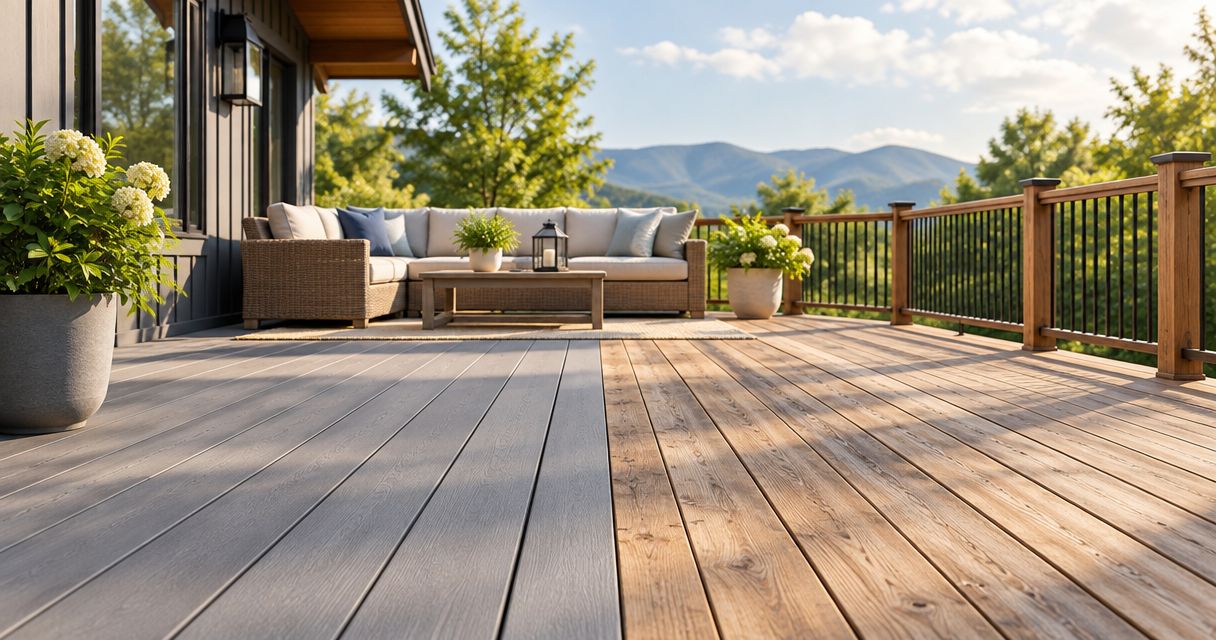
Composite decking has the durability advantage over wood against rot and insects, but neither material has a fixed service life. For a 2026 project, the useful comparison is how the boards weather, what maintenance they require, and whether the framing beneath them remains sound—not a promised replacement date.
- Composite decking lifespan vs wood depends on moisture, installation, maintenance, and the condition of the supporting frame.
- Composite boards resist rot; wood decking needs recurring inspection and finish maintenance appropriate to its species and exposure.
- Replacing deck boards does not repair deteriorated joists, posts, connections, or footings.
- Ayres Construction & Remodeling serves Kentucky and southern Indiana property owners planning decking work.
How long does composite decking last compared to wood?
Composite decking offers better resistance to biological decay; wood offers more repair and refinishing flexibility. Neither advantage establishes an expiration date for your deck. A shaded deck that stays wet presents a different maintenance problem from a ventilated deck that dries after rain.
For help separating board replacement from structural work, Ayres Construction & Remodeling offers decking and general contracting services. Start with the condition of the existing structure before choosing the replacement surface.
The comparison below separates the walking surface from the assembly that supports it. That distinction matters because durable boards cannot compensate for failed connections or deteriorated framing.
| Decision point | Composite decking | Wood decking |
|---|---|---|
| Best for | Owners prioritizing reduced surface-finishing work | Owners prioritizing natural wood and refinishing options |
| Rot resistance | Resists biological decay; follow product requirements for moisture management | Depends on species, treatment, exposure, and maintenance |
| Routine care | Cleaning, drainage checks, and inspection | Cleaning, inspection, and finish maintenance appropriate to the wood |
| Surface restoration | Repair options depend on the board; sanding is not a universal solution | Suitable boards can often be sanded or refinished |
| Structural support | Requires sound framing and product-specific installation | Requires sound framing and appropriate installation |
| Main limitation | Surface damage can require board replacement | Neglected moisture and finish problems can shorten useful life |
A board can remain structurally usable while looking worn. It can also look acceptable while the structure beneath it needs repair. Decide whether you are evaluating appearance, board condition, or whole-deck safety before comparing lifespan claims.
Why this matters
Choosing a deck surface commits you to a maintenance routine, not just a color. Composite reduces the work associated with renewing a wood finish, but it does not remove cleaning, inspection, or repairs from ownership.
For a 2026 deck replacement, separate your scope into surface work and structural work. The first covers boards, trim, and compatible fasteners; the second covers framing, connections, foundations, and any necessary corrections. A proposal that combines everything under a vague replacement description makes those differences harder to evaluate.
The practical decision is whether the material fits both your site and the work you will actually perform. Wood is a poor match for an owner unwilling to maintain its finish. Composite is a poor solution when it is installed over unresolved structural or drainage problems.
Composite decking: less refinishing, not maintenance-free
Composite decking combines manufactured materials rather than relying on solid lumber alone. Formulations and protective surfaces differ, so instructions for one board should not be treated as instructions for every composite product.
Its main lifespan advantage is resistance to the decay problems associated with exposed wood. That does not make the surface immune to scratches, stains, heat damage, or installation problems. Furniture movement, cooking areas, and debris trapped between boards still deserve attention.
Best for: owners who want to avoid recurring wood staining or sealing. Choose composite because its maintenance requirements suit you, not because someone describes it as permanent.
Before selecting a board, read its installation and care documents. Check the required framing support, fasteners, end gaps, ventilation, and cleaning methods. Keep those documents with your project records so future repairs follow the same requirements.
The limitation is repair flexibility. Do not assume you can sand away a damaged area or apply a coating as you would with wood. Ask how the selected product handles scratches, isolated board replacement, and visible weathering before installation.
Wood decking: renewable surfaces, recurring upkeep
Wood decking is not a single durability category. Species, preservative treatment, exposure, and construction details affect performance. Pressure-treated lumber and naturally durable wood should not be treated as interchangeable simply because both are sold as decking.
Wood offers a practical advantage when surface renewal matters. Depending on its condition and previous finishes, a board can be cleaned, prepared, and refinished. Individual damaged boards can also be replaced without assuming that every remaining board has reached the end of its useful life.
Best for: owners who want natural wood and accept recurring finish maintenance. That means inspecting the surface and responding to its condition rather than waiting until splinters, softness, or loose fasteners interfere with use.
The limitation is moisture sensitivity. A finish does not correct water trapped against framing, persistent debris buildup, or unsuitable construction details. Treat finish maintenance and moisture management as separate responsibilities.
When comparing wood options, ask what the specified material requires after installation. Get the care instructions in writing, including any preparation needed before applying a finish. Do not substitute a generic maintenance schedule for the requirements of the actual lumber and coating.
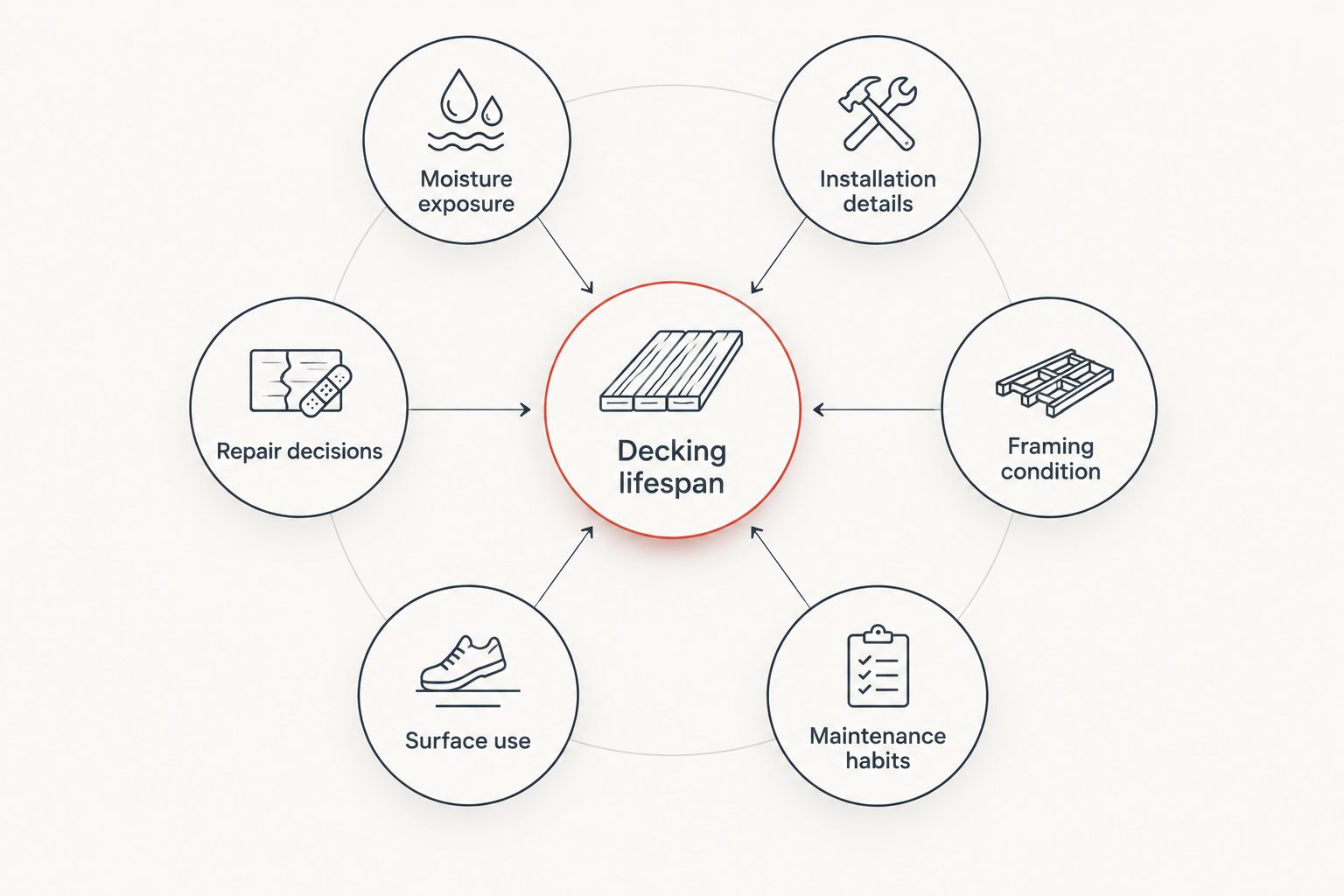
Why decking lifespan varies
The material matters, but the conditions around it determine how it performs. These factors explain why a calendar-based replacement promise is less useful than an inspection and a written scope.
- Moisture exposure: Areas that remain damp need closer attention to drainage, debris, and signs of deterioration.
- Installation details: Fasteners, board gaps, framing support, and attachment details must suit the selected material.
- Framing condition: Worn joists, damaged posts, or deteriorated connections remain problems after new boards are installed.
- Maintenance habits: Cleaning and inspection matter for both materials; wood also needs appropriate finish care.
- Surface use: Furniture, cooking equipment, planters, and concentrated wear affect how the surface looks and performs.
- Repair decisions: Prompt repairs can address isolated defects before continued use or moisture exposure makes the problem more extensive.
These factors work together. For example, a planter that holds debris against a board creates a different exposure from an open section of the same deck. Inspect the difficult spots rather than judging the entire structure from its cleanest area.
Can you put composite decking on an existing wood frame?
Composite decking can go on an existing wood frame only when the frame is sound and meets the selected product's installation requirements. Keeping the framing is a construction decision, not an automatic saving built into a board replacement.
Ask the contractor to inspect the accessible structure before defining the work. Some conditions remain concealed until boards are removed, so the proposal should explain how newly exposed damage will be documented and handled.
Use this sequence when planning the work:
- Inspect the structure. Review accessible joists, beams, posts, connections, stairs, and attachment points for deterioration or movement.
- Check product requirements. Compare the existing framing arrangement with the selected composite board's installation instructions.
- Define repairs. Separate necessary structural corrections from optional appearance changes.
- Confirm the scope. Identify removal, disposal, framing work, boards, fasteners, trim, stairs, and railings in the proposal.
- Document changes. Require approval of additional work before concealed damage changes the agreed project scope.
Board thickness alone does not establish compatibility. Framing layout and installation requirements still control how the finished surface is supported.
Do not cover an unresolved framing problem because the new surface looks better. A new deck surface is not a structural repair.
Does a composite decking warranty tell you its lifespan?
A composite decking warranty describes specified coverage, not a guaranteed whole-deck lifespan. Read what the document covers before treating its duration as a replacement forecast.
Product coverage and installation responsibility are different subjects. A material document does not automatically cover labor, removal, disposal, framing repairs, or every change in appearance. The actual terms control, so request the documents for the exact board under consideration.
For a 2026 proposal, keep the product identification, care instructions, installation requirements, and warranty together. Those records help you identify the material later and distinguish a product concern from a construction or maintenance issue.
Apply the same discipline to wood. Ask for the lumber specification and any applicable treatment documentation instead of relying on a broad statement that the deck is protected.
Is composite decking worth choosing over wood?
Composite is the better fit when reducing finish maintenance is your priority; wood is the better fit when natural material and refinishing flexibility matter more. Neither choice removes the need for sound construction.
Compare the work you will accept after installation. If you will not keep up with a wood finish, do not choose wood on the assumption that you will develop a new maintenance habit. If you prefer repairing and renewing a natural surface, do not dismiss that benefit merely because composite needs less finishing work.
Look at samples where the deck will sit. Evaluate texture, appearance, and the manufacturer's stated care requirements together. A sample helps you judge the surface, but it does not replace a review of structural support or installation details.
For a larger new-home project, settle deck access, stairs, drainage, and connections during planning. Those decisions belong in the construction scope, not in a last-minute material substitution.
What should your decking estimate include?
A useful estimate identifies what stays, what comes out, and what replaces it. In 2026, compare proposals against the same written scope rather than assuming that every contractor means the same thing by a new deck.
Ask for clear treatment of:
- Existing board removal and disposal.
- Framing inspection and specified structural repairs.
- Decking material, fastening system, and installation requirements.
- Railings, stairs, fascia, and other finish components.
- Drainage or site-work changes included in the project.
- Exclusions and the approval process for additional work.
Ayres Construction & Remodeling is best suited to Kentucky and southern Indiana property owners seeking a local, licensed and insured decking contractor. The company is based in Bowling Green, Kentucky; a project estimate should still define your property's specific conditions and construction scope.
Use the contact page to request a project estimate. Describe whether you need surface replacement, structural repairs, or a new deck, and identify any visible movement, soft areas, or drainage concerns.
Request a decking project estimate
Discuss deck boards, framing condition, removal, and the work your project requires.
FAQ
Does composite decking last longer than wood?
Composite decking has better resistance to rot and insects than wood, but the installed deck's useful life also depends on framing, moisture, and workmanship. Compare maintenance and construction requirements rather than treating either material as permanent.
Will composite decking make my old deck safe?
Composite decking does not make deteriorated framing safe. Existing joists, beams, posts, connections, stairs, and attachment points need inspection before you commit to resurfacing.
Do I still need to clean composite decking?
Composite decking still needs cleaning and inspection. Follow the selected manufacturer's care instructions and remove debris that interferes with drainage.
Can I sand composite decking like wood?
Do not assume composite decking can be sanded like wood. Surface restoration and repair methods depend on the specific product, so check its instructions before attempting repairs.
Is pressure-treated wood maintenance-free?
Pressure-treated wood is not maintenance-free. It still needs inspection, cleaning, and finish care appropriate to the lumber, exposure, and coating system.
Should I replace every deck board if only some are damaged?
Isolated board damage does not automatically require replacing the entire surface. Inspect the cause, surrounding boards, and supporting frame before deciding between a localized repair and broader replacement.
What should I ask a decking contractor in 2026?
Ask a decking contractor in 2026 to separate surface replacement from structural repairs and identify exclusions in writing. Ayres Construction & Remodeling offers decking services in Kentucky and southern Indiana.
One last thing
Inspect the underside before choosing the surface. The most useful early decision is not a board color or a lifespan claim; it is whether the existing structure is suitable for the work you want.
For your 2026 project, request a scope that connects the visible finish to the less visible construction beneath it. You will make a clearer material choice when board replacement, structural repairs, and maintenance responsibilities are separate decisions.