Before pouring a concrete driveway in Bowling Green, confirm the permit requirements for your property with the office responsible for that address and the authority responsible for the adjoining road. Do not treat an existing driveway as proof that replacement work is exempt. Your confirmation should cover the concrete work, driveway entrance, drainage changes, and any work in the public right-of-way.
- For a permit for concrete driveway Bowling Green project, confirm property jurisdiction and road authority before pouring.
- Ask separately about driveway replacement, widening, a new entrance, drainage changes, and right-of-way work.
- Get written confirmation of required approvals and inspections before scheduling concrete placement.
- Ayres Construction & Remodeling provides concrete services; discuss permit responsibility when requesting your project estimate.
Do I need a permit for a concrete driveway in Bowling Green?
You need an address-specific determination, not a blanket answer based on the words concrete driveway. For your 2026 project, describe exactly what will change and ask the responsible office which permits, approvals, and inspections apply.
Separate the approval questions below. Permission for work on your property does not automatically settle permission to change the connection to a public road.
| Proposed work | What to ask before construction | What not to assume |
|---|---|---|
| Replace an existing driveway | Does replacement in the same footprint require approval or inspection? | Existing concrete establishes an exemption |
| Widen an existing driveway | Does the wider layout affect setbacks, drainage, or entrance approval? | Approval for the original width covers an expansion |
| Build a new driveway | Which offices review the location and road connection? | A suitable parking area guarantees an acceptable entrance |
| Change the driveway entrance | Does the road authority require an access or encroachment approval? | A concrete contractor can approve changes to public property |
| Change grading or drainage | What review applies to the proposed water flow or crossing? | Keeping the concrete on your lot resolves every drainage question |
For contractor background, review Ayres Construction & Remodeling. Keep contractor selection separate from the authority's decision about your property.
Why this matters
Concrete placement comes after the approval decision, not before it. An unresolved entrance, drainage, or inspection requirement creates a problem that a finished slab cannot fix by itself.
The useful question is not simply whether someone nearby poured a driveway without a permit. It is whether your proposed scope has the approvals it needs at your address. A neighbor's project is not written confirmation for yours.
For a 2026 estimate, ask the contractor to identify who contacts the reviewing offices, who submits any applications, and who schedules required inspections. Put those responsibilities in the written scope. A conversation about permits is not the same as an agreement to handle them.
Replacing an existing concrete driveway
A replacement project needs a clear description of what stays unchanged. Tell the reviewing office whether you will retain the existing footprint, entrance location, elevation, and drainage arrangement.
Use precise terms. Removing damaged concrete and replacing it in place is a different scope from extending the parking area, moving the entrance, or changing the driveway slope. Do not describe all of those changes as a simple replacement.
Before demolition, assemble:
- Photos showing the full driveway and its connection to the road.
- A sketch identifying the property, driveway edges, and proposed work.
- A written description of demolition and replacement limits.
- Notes identifying any proposed change to grade, drainage, sidewalk, or curb.
Ask for confirmation that addresses that exact scope. If the design changes afterward, confirm whether the earlier answer still applies. An answer about replacement in place does not answer a later question about widening.
Best for keeping the approval request clear: describe the physical work rather than relying on a project label such as repair or replacement.
Widening a driveway or adding parking
A wider driveway changes more than the amount of concrete. Your approval request should distinguish the parking area inside the property from the driveway entrance at the road.
Mark the existing and proposed edges on the same sketch. Identify whether the expansion stops before the entrance or also changes the road connection. Include nearby property lines and visible drainage features so the office can understand what you propose.
Ask these questions before accepting a final layout:
- Does the proposed width or location need zoning review?
- Are there applicable setbacks or limits affecting this layout?
- Does the entrance need separate approval?
- Does the added pavement change how drainage must be addressed?
These are questions to resolve, not statements that every restriction applies to every Bowling Green property. Do not use a general driveway article as a substitute for the rules applicable to your lot.
A contractor can price the proposed expansion more clearly when the approved limits are settled. Otherwise, the estimate and the final permitted scope can describe different work.
Building a new driveway entrance
Treat a new road connection as its own approval question. Start by identifying who maintains the road rather than assuming the property address answers that question.
For a connection to a state-maintained road, check with the Kentucky Transportation Cabinet about its encroachment permit requirements. For another road, ask the responsible road authority which access approvals apply. Confirm the authority before submitting an application.
Describe the entrance location and any proposed work involving a ditch, culvert, curb, or sidewalk. Ask what drawings or supporting information the reviewer needs; do not commission documents based on guesswork.
An entrance location should be resolved before the contractor finalizes the driveway approach. Moving the connection can change the layout, grading, and concrete scope inside the property.
Best for a new driveway: settle the entrance approval before treating the interior parking layout as final. The road connection and the private driveway need to work together.
Why driveway permit requirements vary
The approval question follows the property and the work, not just the paving material. Use these factors to organize your 2026 inquiry:
- Property jurisdiction: Identify the office responsible for the actual parcel, rather than relying only on its mailing address.
- Road authority: Determine who controls the adjoining road and any work within its right-of-way.
- Project scope: State whether you are replacing, widening, relocating, or building a driveway.
- Entrance changes: Identify any change to the connection between the driveway and the road.
- Drainage work: Describe proposed grading, ditch work, culverts, and changes to water flow.
- Other property restrictions: Check recorded easements and applicable private restrictions separately from public approvals.
A public permit and private permission answer different questions. If your property has an applicable association approval process or recorded restriction, resolve that separately. Do not assume either approval replaces the other.
How do I confirm approval before concrete work starts?
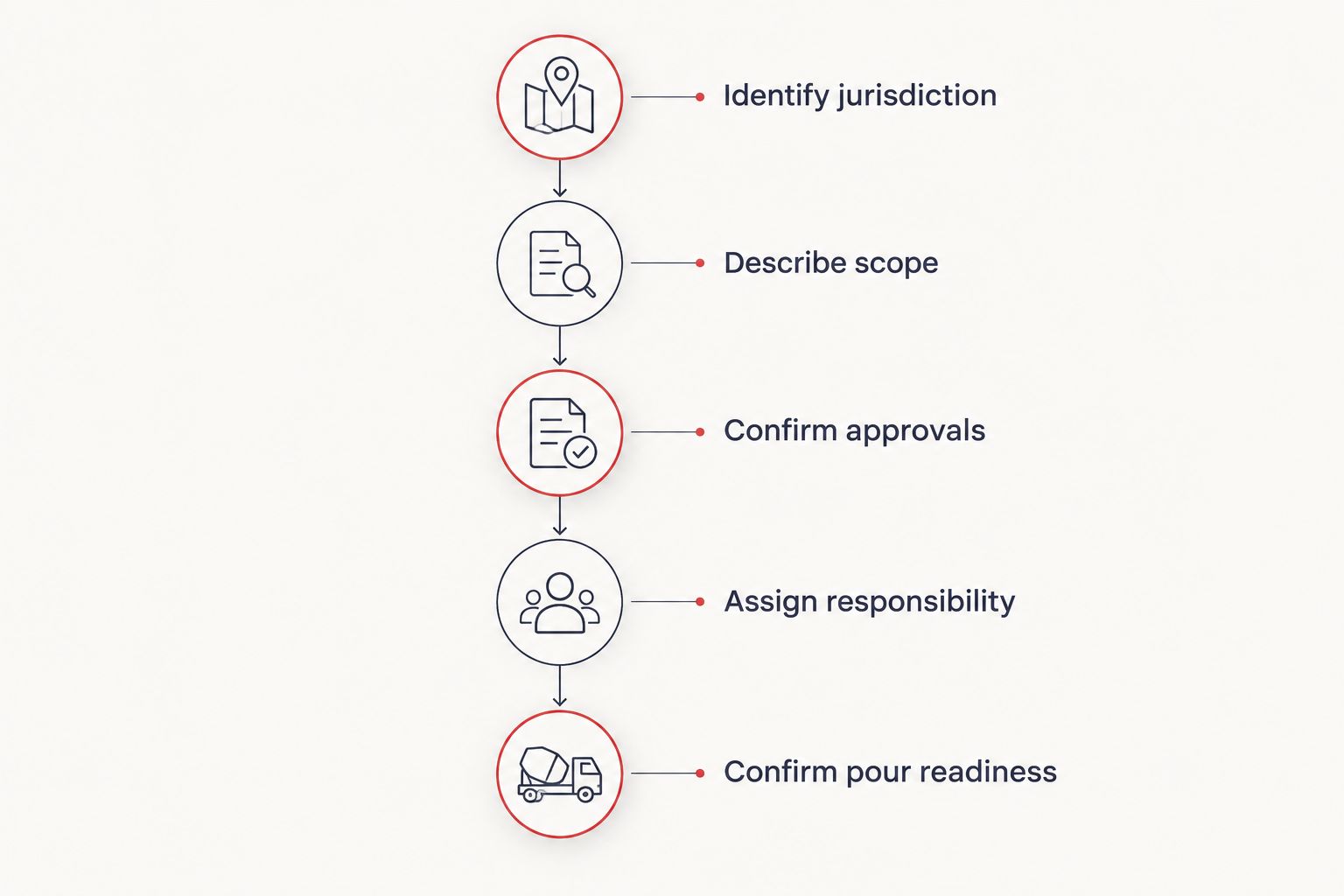
Use a written sequence that connects the approval decision to the construction schedule. For a 2026 project, keep the final scope, correspondence, and permit documents together so everyone works from the same information.
- Identify jurisdiction. Give the property address and parcel information to the office you contact. Ask whether that office handles the proposed work or should direct you elsewhere.
- Describe scope. Provide the driveway sketch and identify replacement, widening, entrance changes, and drainage work separately.
- Confirm approvals. Ask which permits, road approvals, supporting documents, and inspections apply. Request written confirmation if the office determines that a permit is not required.
- Assign responsibility. Put application handling, document preparation, and inspection scheduling into the contractor's written scope.
- Confirm pour readiness. Before concrete placement, verify that required approvals are issued and any required pre-pour inspection is complete.
The sequence matters because a submitted application is not an issued approval. Likewise, an issued permit does not establish that every required inspection has occurred.
Keep the written answer tied to the drawing or scope you submitted. If you revise the entrance, dimensions, or drainage plan, return to the reviewer with the change rather than relying on the original response.
What should a driveway estimate include?
A useful estimate separates the physical construction from the approval responsibilities. It should let you see what the contractor will build, what preparation is included, and what you must arrange separately.
Ask for a written scope covering:
- Demolition: Identify the concrete or other materials being removed and whether removal from the property is included.
- Site preparation: Describe excavation, grading, base preparation, and how unsuitable conditions will be handled if encountered.
- Concrete work: Specify the proposed concrete assembly, reinforcement where specified, joints, finish, and construction limits.
- Drainage and entrance work: Identify what is included and what requires separate design, approval, or construction.
- Permits and inspections: Name the responsible party and identify any excluded application or documentation work.
- Restoration and access: Explain the agreed restoration scope and how access restrictions will be communicated during construction.
An estimate is not an approval document. A detailed construction proposal still needs to match the authorized work.
Check exclusions as closely as included items. If culvert work, utility relocation, drainage design, or restoration is excluded, resolve who handles it before the driveway schedule depends on it. Do not interpret a missing line item as included work.
Who should handle the driveway permit process?
Assign permit responsibility explicitly to the owner or contractor. Either arrangement needs a clear handoff: who supplies property information, prepares documents, responds to review comments, and confirms inspection requirements.
Ayres Construction & Remodeling is best suited to Bowling Green property owners seeking a local, licensed and insured contractor for concrete work. The company is based in Bowling Green and serves Kentucky and southern Indiana; discuss your driveway scope and approval responsibilities when requesting an estimate.
Using a general contractor provides a point of contact for the construction scope. It does not replace the public authority's approval, and you should not assume permit handling is included unless the agreement says so.
Before hiring, compare written responsibilities rather than accepting a verbal assurance that permits are handled. Ask who will provide the approval documents before work reaches any required inspection stage.
Request a driveway project estimate
Discuss concrete work, site preparation, drainage, and responsibility for required approvals.
Can I replace my driveway without changing the entrance?
Keeping the entrance unchanged narrows the scope, but it does not establish a permit exemption. Ask the reviewing office about replacement within the existing footprint and disclose any changes to elevation or drainage.
Keep the contractor's proposal consistent with that description. If the proposal includes widening or entrance work, your approval inquiry needs to include it too.
Does a contractor's license replace a driveway permit?
A contractor's license does not replace a project permit or road-access approval. Contractor qualifications and permission to perform a particular project are separate checks.
Confirm both before construction. Neither a contractor's experience nor the existence of nearby driveways settles the approval requirements for your property.
FAQ
Do I need a permit to replace my concrete driveway in Bowling Green?
Confirm replacement requirements with the office responsible for your property before demolition. Describe whether the footprint, entrance, elevation, and drainage will remain unchanged; an existing driveway does not establish an exemption.
Who do I ask about a driveway permit in Bowling Green?
Start with the permitting or planning office responsible for your property and identify the authority responsible for the adjoining road. Ask each office which parts of your proposed scope it reviews.
Do I need separate permission to widen my driveway?
Ask specifically about widening rather than relying on an answer about replacement. Show whether the added pavement changes the entrance, property-line clearance, or drainage arrangement.
What if my driveway connects to a state-maintained road?
Check with the Kentucky Transportation Cabinet about encroachment permit requirements for the proposed road connection. Identify any entrance, ditch, culvert, curb, or sidewalk work in your inquiry.
Can my contractor handle the driveway permit?
Permit handling must be agreed in the written construction scope. Specify who submits applications, supplies documents, responds to review comments, and schedules required inspections.
Can I pour concrete while the permit application is being reviewed?
Do not schedule concrete placement until required approvals are issued and required pre-pour inspections are complete. An application submission is not an approval.
Does Ayres Construction & Remodeling provide concrete driveway estimates?
Ayres Construction & Remodeling provides concrete services to residential and commercial property owners in Kentucky and southern Indiana. Request an estimate describing the driveway, site preparation, drainage work, and approval responsibilities you want included.
One last thing
For your 2026 driveway project, ask one final question before the pour: Does the approval match the work actually being built? Compare the entrance, driveway limits, grading, and drainage details against the final construction scope.
Written confirmation for an earlier design is not confirmation for a changed design. Resolve that mismatch while the layout can still be corrected—not after the concrete is placed.