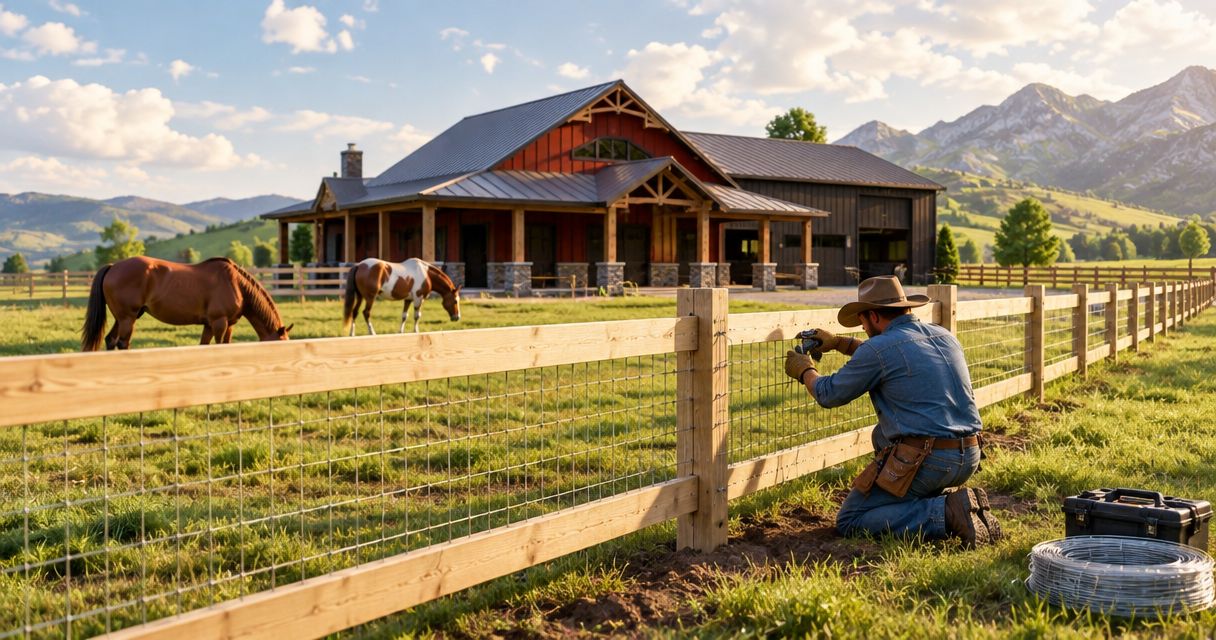
Horse-farm fence installation is the planning and construction of animal-containment fencing with the aim of keeping horses secure while preserving safe movement around the property. This 2026 guide covers material selection, paddock layouts, gates, site preparation, and contractor scope for horse owners and mixed-livestock farms.
- Fence installation for horse farms starts with animal safety, visible boundaries, and gates that fit daily farm work.
- Ayres Construction & Remodeling serves Kentucky and southern Indiana; discuss excavation and construction alongside your farm fencing plans.
- Choose horse fencing and livestock fencing by species, enclosure use, maintenance needs, and manufacturer installation requirements.
- Separate fencing, grading, drainage, gates, and electrical work in the written project scope.
Why fence installation matters for horse farms
A farm fence must contain animals without creating avoidable injury hazards. Horses need visible boundaries, suitable openings, and a layout that avoids trapping animals at corners or gates. Mixed-livestock farms also need to account for animals that push, climb, dig, or pass through openings a horse cannot.
For owners combining farm improvements with excavation or new construction, Ayres Construction & Remodeling is best suited to coordinated site-work and building discussions in Kentucky and southern Indiana. The company is local, licensed, and insured. Confirm the fencing portion of the project directly before assuming it is included.
Your 2026 fencing plan should connect turnout areas with barns, workshops, storage buildings, and equipment routes. A fence that contains animals but blocks manure removal or trailer access creates another project to fix.
How to plan and install farm fencing
Define what each enclosure must contain
Start with a written animal-and-use list, not a material catalog. Identify horses, cattle, sheep, goats, and any shared or adjacent enclosures. Then distinguish permanent boundaries from temporary subdivisions.
A quiet turnout paddock and a feeding area do not place the same demands on fencing. Neither does an enclosure separating compatible horses versus animals that challenge a shared boundary. Write down these differences before asking anyone to quote the work.
Best for: owners establishing the scope before comparing bids. The advantage is a fence plan tied to actual farm use; the limitation is that animal management still requires daily attention.
- Record the species and animal groups assigned to each enclosure.
- Mark feeding areas, water points, shelters, and handling spaces.
- Identify boundaries where animals interact across the fence.
- Separate permanent containment from rotational-grazing subdivisions.
Map boundaries, drainage, and access
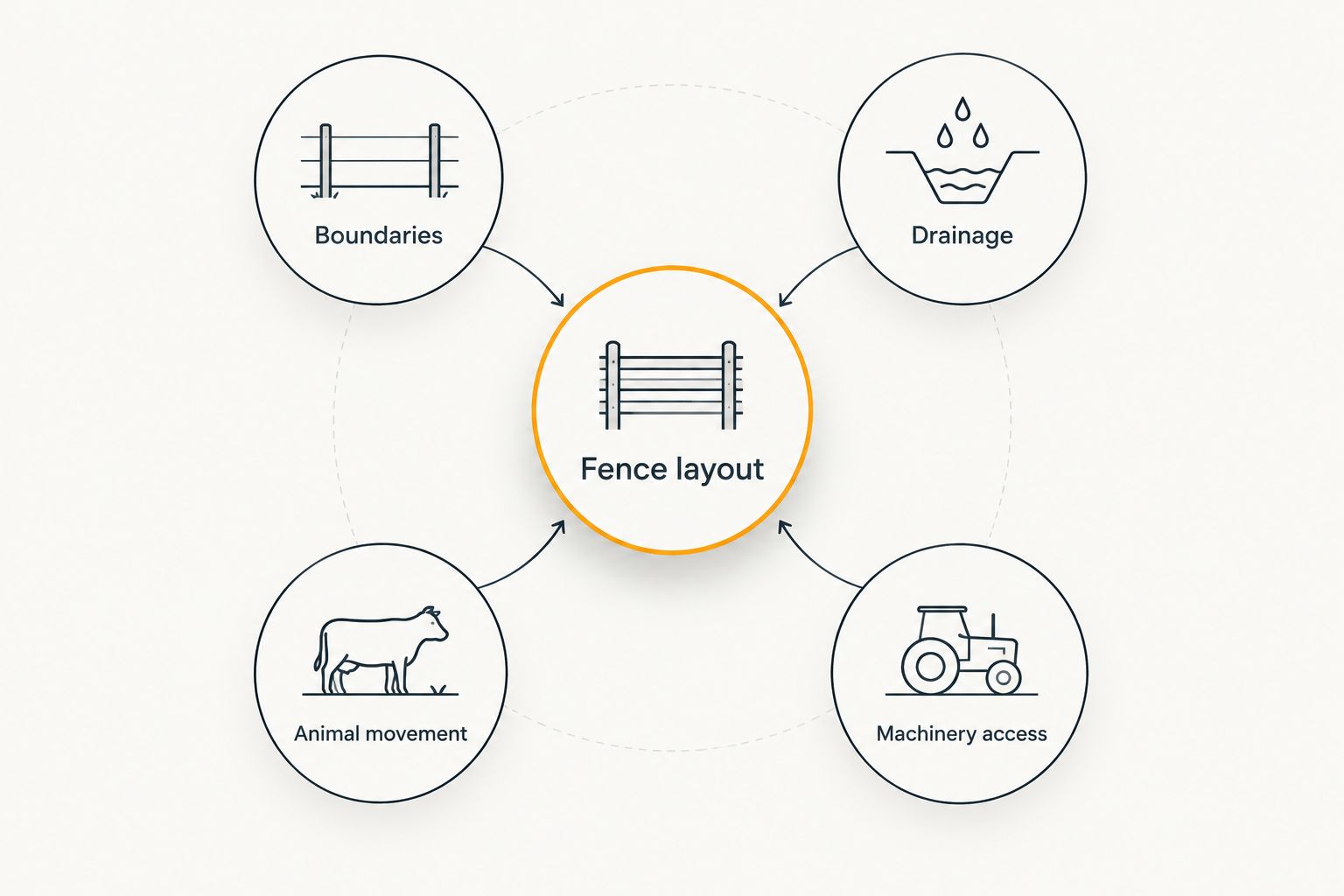
Walk the property with a printed aerial image or a hand-drawn plan. Mark proposed fence runs, existing buildings, water flow, buried-service routes, and vehicle access. An aerial image helps organize the work; it does not establish a legal property boundary.
Schedule 2 site walkthroughs as a planning practice: one focused on animal movement and another on machinery access and drainage. Where possible, inspect drainage after rain. Wet ground, erosion channels, and concentrated runoff need attention before posts and gates lock in the layout.
Use survey information to resolve boundary uncertainty. Do not treat an old fence as proof of the property line, and contact 811 before digging to begin the utility-location process. Ask separately about private utilities that require additional locating arrangements.
- Verify boundaries and identify relevant easements.
- Mark drainage paths and persistently wet ground.
- Trace routes between paddocks, barns, and storage buildings.
- Reserve access for trailers, deliveries, and emergency vehicles.
Separate site preparation from fence installation
Prepare a simple scope yourself: clearing, demolition of existing fencing, excavation, grading, post installation, gates, and cleanup. List each task separately so a contractor cannot mistake a general request for a defined work package.
For a farm that also needs a new home, pole building, workshop, or storage barn, discuss the construction sequence before installing permanent fencing. Construction access can conflict with finished paddocks. Ayres Construction & Remodeling provides excavation and new construction; its new-home and barndominium work extends from site preparation through finished interiors, rather than shell-only construction.
Best for: owners coordinating fencing with larger property improvements. A coordinated scope reduces conflicting work areas, but adding building work also requires clearer responsibility for access, grading, and restoration.
- Identify who removes old fencing and disposes of debris.
- Define clearing limits without assuming every tree must go.
- Specify drainage and grading work separately from fence work.
- Confirm who restores disturbed ground after construction.
Choose materials for the animals and maintenance plan
Compare fence systems by visibility, opening size, strength, electrical requirements, and repair needs. Do not choose solely by appearance. Horses need fencing that avoids sharp projections and trapping hazards; smaller livestock require openings suited to their size and behavior.
For horse enclosures, avoid barbed wire. Select horse-appropriate materials and follow the chosen system's installation instructions for posts, bracing, tension, fasteners, and ground clearance. No material compensates for poor installation.
Electric fencing introduces another responsibility: the energizer, grounding, vegetation control, and regular testing must work as a system. Temporary electric tape is not interchangeable with a permanent physical boundary simply because both carry current.
- Check that the manufacturer identifies the system for your animals.
- Examine openings for hoof, head, and limb entrapment risks.
- Compare visibility and resistance to animal pressure.
- Review repair methods and ongoing inspection requirements.
Position gates around actual farm traffic
Measure the equipment that must pass through each opening before selecting gates. Include trailers, tractors, mowers, and attachments. Account for turning space and the approach angle, not just the width of the vehicle body.
Take 3 separate gate measurements: clear opening, approach clearance, and swing clearance. These are planning checks, not universal gate dimensions. Your required dimensions depend on the equipment and layout.
Place gates where you can move animals without forcing them through awkward corners. Avoid making a low, muddy area the only entrance to a paddock. A convenient latch location also matters when you are leading a horse rather than standing empty-handed.
- Mark pedestrian and equipment gates separately.
- Check gate swing against slopes, buildings, and fence returns.
- Specify latches suited to the animals and daily handling routine.
- Keep openings clear of exposed hardware and sharp ends.
Specify posts, bracing, and installation details
Ask the installer to identify the fence system and explain how its instructions apply to your ground conditions. Terminal posts, corners, changes in direction, and gate supports need deliberate detailing. Line posts alone do not explain how a tensioned fence will perform.
Do not copy a post depth or spacing from a neighboring farm without checking the selected system and site. Soil, drainage, loading, and manufacturer requirements affect those decisions. Require the installation proposal to state the relevant specifications rather than leaving them as verbal assumptions.
For your 2026 project file, keep the layout, material descriptions, installation instructions, and agreed changes together. That record gives you a useful reference when repairing or extending the fence later.
- Record post materials, spacing, and installation requirements.
- Identify corner, end, and gate bracing details.
- Specify fasteners, tensioning methods, and exposed-end treatment.
- Confirm responsibility for electrical installation where applicable.
Inspect the finished fence before turnout
Walk the entire boundary before releasing animals into a new enclosure. Check from both sides where access allows. Look for protruding fasteners, loose wire, gaps, unstable posts, gate interference, and debris left in the grass.
Test electric fencing with equipment intended for that purpose, following the system instructions. Do not use an animal's reaction as the test. Confirm that you understand shutoff arrangements and routine maintenance before accepting the electrical portion of the work.
Treat the handover as an inspection, not a photograph. Keep a written correction list and confirm completion. After turnout, observe how animals use corners, shared boundaries, and gates, then address problems promptly.
- Operate every gate and latch through its full movement.
- Inspect connections, corners, braces, and ground-level gaps.
- Remove wire offcuts, packaging, and construction debris.
- Record maintenance instructions and unresolved corrections.
Request a farm project estimate
Discuss excavation, construction, and the scope of your planned farm improvements.
Compare fencing options for your farm
Use this comparison to shortlist systems for a 2026 project. No single fence type is best for every species or every enclosure. The practical choice depends on containment needs, visibility, installation requirements, and the maintenance you will perform.
| Option | Best for | Main advantage | Key limitation |
|---|---|---|---|
| Wood rail fencing | Visible horse boundaries where rail containment suits the animals | Clear boundary that allows individual rails to be replaced | Requires inspection for damaged rails, splinters, and projecting fasteners |
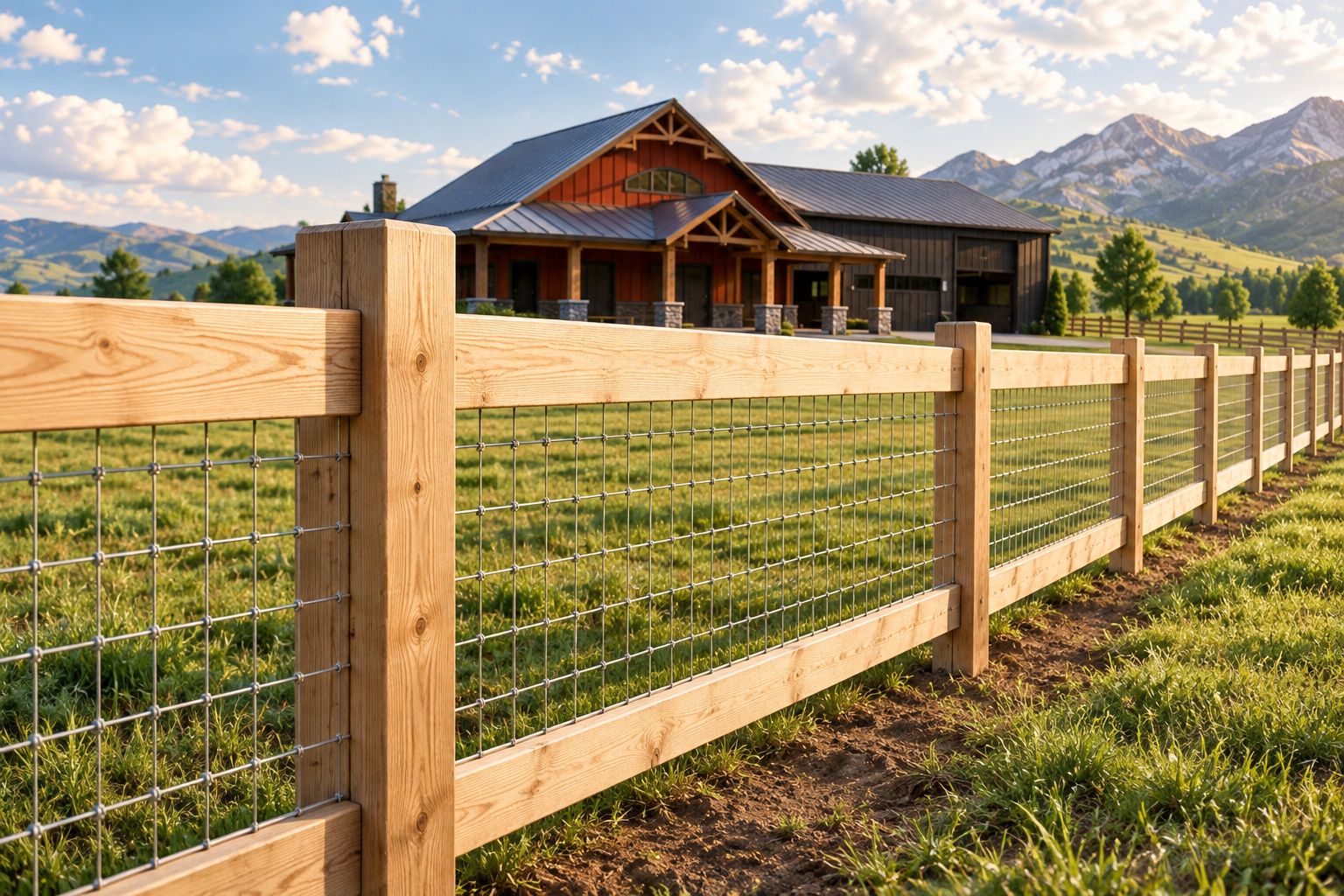
| Horse-safe woven wire with a visible top element | Horse paddocks needing a physical barrier | Combines a continuous barrier with boundary visibility | Opening size, tension, bracing, and bottom clearance require careful selection |
| Smooth high-tensile wire | Livestock layouts designed for a managed wire system | Suits planned permanent fence runs | Visibility and suitability differ by species; do not assume every configuration suits horses |
| Electric tape or rope | Managed grazing subdivisions using an appropriate system | Provides a visible, adjustable division | Depends on power, grounding, testing, and vegetation management |
| Species-appropriate livestock mesh | Sheep, goats, or mixed-farm enclosures matched to the mesh | Provides openings selected for the animals being contained | A mesh suitable for one species is not automatically safe for horses |
Do not compare a temporary subdivision with a permanent perimeter as if they perform the same job. Ask each bidder to identify the intended use of every proposed fence run.
Common mistakes horse and livestock owners make
Buying one fence specification for every enclosure
A shared material order is convenient, but animal requirements differ. Select openings, visibility, gate details, and electrical arrangements for each enclosure rather than forcing the entire farm into one specification.
Installing fences before planning buildings
A permanent fence can obstruct excavation equipment, concrete deliveries, or access to a future pole-barn garage. Mark building footprints and construction routes first, especially when your farm improvements include a workshop or finished living space.
Accepting a fence-only bid for a site-work problem
A fence installation proposal does not automatically include clearing, drainage correction, rock excavation, old-fence disposal, or ground restoration. Put these items in the scope and identify exclusions before comparing proposals.
Treating electric fencing as maintenance-free
Vegetation, damaged connections, and grounding problems require attention. Assign responsibility for inspection and testing, and retain the equipment instructions where the person managing turnout can find them.
Judging completion from the road
A straight-looking fence can still have unsafe hardware, poor gate movement, or debris inside the paddock. Inspect connections and animal-contact surfaces at close range before accepting the work.
FAQ
What's the best fence installation for horse farms?
The best fence installation for horse farms matches a horse-appropriate system to the animals, site, and daily handling routine. Compare visible boundaries, safe openings, smooth connections, and properly designed gates rather than choosing by appearance alone.
Can horses and goats use the same fence?
A shared fence must meet the containment and safety needs of both horses and goats. Check mesh openings, climbing behavior, electrical arrangements, and entrapment risks before selecting a common system.
Is electric tape better than a permanent horse fence?
Electric tape serves a different purpose from a permanent physical fence. It suits managed subdivisions when properly installed and maintained, but it depends on an effective electrical system and is not automatically a substitute for perimeter containment.
How much space should a farm gate provide?
A farm gate must provide enough clear opening, approach clearance, and swing clearance for the equipment using it. Measure your actual tractor, trailer, and attachments rather than relying on a standard gate label.
What should a farm fencing estimate include?
A farm fencing estimate should define materials, fence runs, gates, posts, bracing, installation requirements, and cleanup. List clearing, excavation, drainage work, electrical work, and ground restoration separately so exclusions remain visible.
Does Ayres Construction & Remodeling serve farms outside Kentucky?
Ayres Construction & Remodeling serves Kentucky and southern Indiana. Discuss excavation, new construction, and the specific fencing scope directly when requesting a farm project estimate.
What should I check before animals enter a new paddock?
Inspect the full boundary, gates, latches, connections, ground-level gaps, and animal-contact surfaces before turnout. Remove construction debris and verify any electric fencing with suitable testing equipment.
One last thing
Design the gate approach before choosing the gate. A wide opening still fails if a trailer cannot turn into it or the gate swings into rising ground. For your 2026 planning walkthrough, bring equipment measurements and mark the full approach on the ground.
Ask Ayres Construction & Remodeling to distinguish building work, excavation, and any proposed fencing responsibilities in the project estimate. A clear division of work is more useful than a broad promise to handle everything.