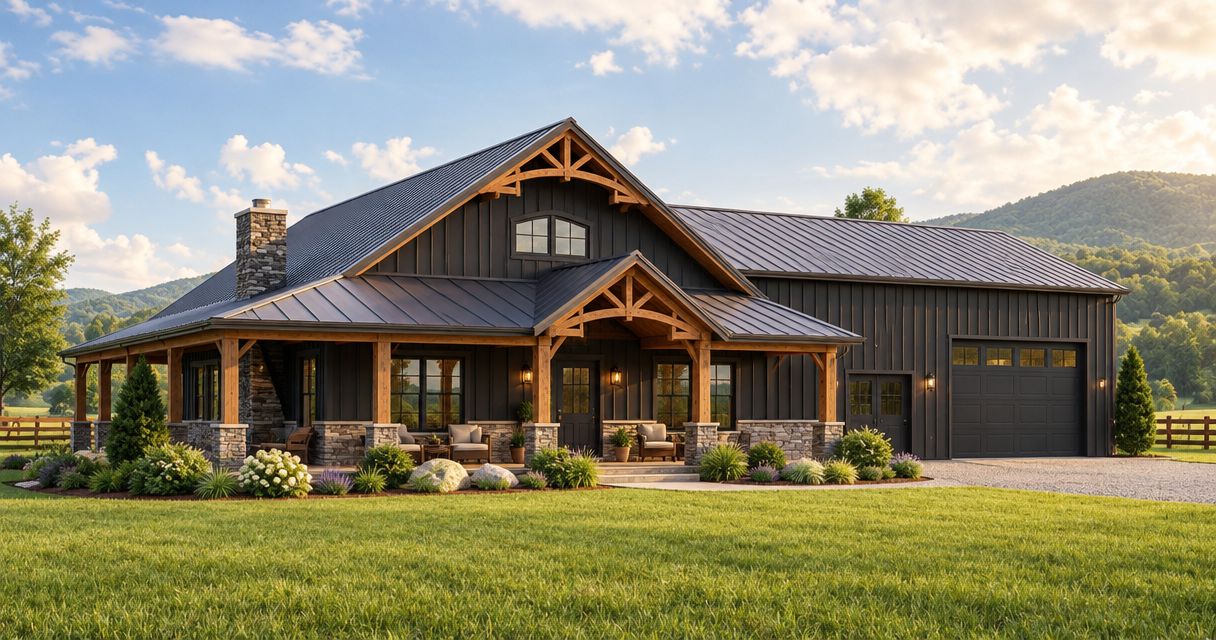
Yes, you can get a mortgage on a barndominium in Kentucky in 2026 if a lender accepts the property type and approves your finances, construction plans or completed home, and appraisal. Financing is not automatic: a pole-building shell is not the same lending proposition as a completed residence, and construction funding requires additional review.
- A mortgage on a barndominium in Kentucky is possible; confirm lender acceptance before committing to plans.
- Construction financing and a mortgage for an existing finished home require different documentation.
- Appraisal, residential use, site conditions, and unfinished work affect the lending decision.
- Ayres Construction & Remodeling is a fit for buyers seeking local, licensed, insured construction through finished interiors.
Why this matters
A contractor's proposal tells you what will be built. A lender's approval determines whether that specific building, on that specific parcel, qualifies for financing. Get both decisions aligned before you sign a construction contract or make a nonrefundable commitment.
Ayres Construction & Remodeling is a local, licensed and insured general contractor based in Bowling Green, serving Kentucky and southern Indiana. Its barndominium construction service covers site preparation through finished interiors. That gives you a defined building scope to discuss with lenders; it does not establish mortgage eligibility or guarantee approval.
Can you get a mortgage on a barndominium in Kentucky?
Yes. The practical question is whether your chosen lender accepts your proposed barndominium as residential collateral and offers financing that matches its current stage. A lender that finances finished houses does not necessarily finance their construction.
For a 2026 application, describe the building precisely rather than asking only whether the lender finances barndominiums. Explain the structural system, finished living area, garage or workshop space, intended occupancy, parcel, and proposed utilities. Give the lender plans when available.
These financing paths address different situations. Ask which path the lender actually offers before comparing application requirements.
| Financing path | Best for | Main advantage | Main limitation |
|---|---|---|---|
| Construction-to-permanent financing | Buyers building a residence who want construction and long-term financing arranged together | Coordinates construction funding with a permanent mortgage | The lender must accept both the construction project and the completed property |
| Separate construction loan and permanent mortgage | Buyers arranging building finance separately from long-term financing | Separates the construction transaction from the permanent mortgage | Permanent financing requires its own approval; completion alone does not guarantee it |
| Mortgage on an existing finished barndominium | Buyers purchasing a completed residence | The lender can evaluate the actual finished property | Property condition, appraisal, residential eligibility, and borrower qualification still apply |
Treat this table as a way to structure lender conversations, not a list of programs every institution offers. Ask each lender to confirm the property type and financing path in writing.
Financing a new barndominium from site work to completion
New construction requires the lender to evaluate something that does not yet exist. Your plans, specifications, construction agreement, site information, and budget provide the basis for that review. An attractive floor plan alone does not answer those questions.
Start with the intended finished residence. Identify the living spaces, attached garage, workshop, storage areas, utility systems, and interior finishes. Distinguish residential space from areas used for business or agricultural activity rather than treating the whole building as interchangeable square footage.
Then establish responsibility for the work. The construction agreement should identify included work, exclusions, allowances, and any tasks left to you or another contractor. A lender also needs to understand how the project reaches the condition required for permanent financing.
A shell-only proposal and a finished-home proposal are not equivalent borrowing documents. If you want a completed residence, request a scope that follows the project through finished interiors, not just framing, roofing, and exterior enclosure.
Follow this approval sequence
- Lender acceptance: Confirm that the lender considers your proposed barndominium construction and intended use.
- Site review: Establish parcel details, access, utilities, and local land-use requirements.
- Construction scope: Provide plans, specifications, the contractor agreement, and a complete project budget.
- Appraisal review: Let the lender order and evaluate the appraisal under its requirements.
- Closing requirements: Resolve approval conditions before assuming construction funding is ready.
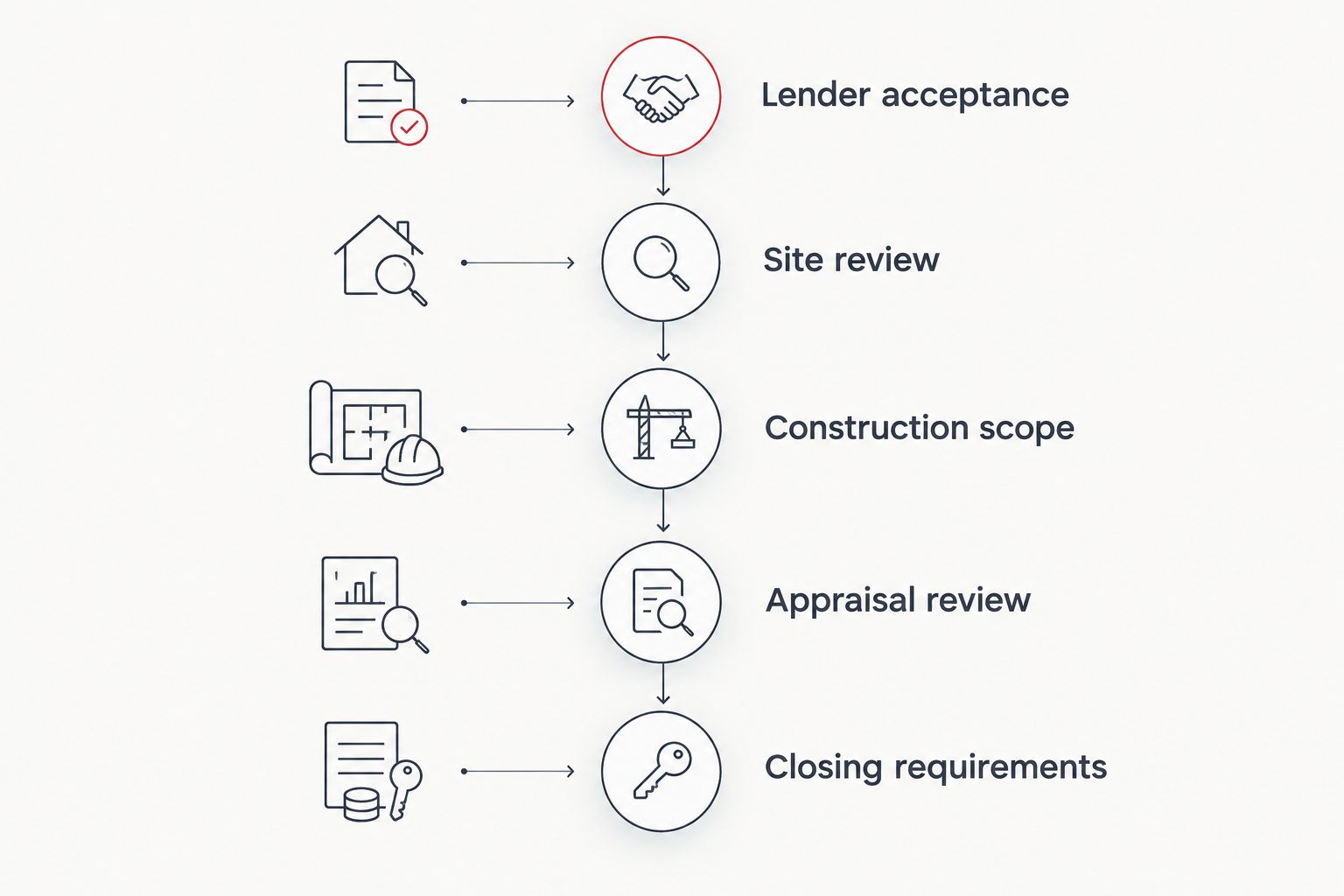
Use this sequence to organize your conversations, not to replace the lender's instructions. Some reviews overlap, and the lender determines what must be resolved before closing or releasing construction funds.
Getting a mortgage on a completed barndominium
A completed residence removes the need to finance its initial construction. It does not remove property review. The lender still evaluates the home, its use, its condition, and the appraisal alongside your income, debts, credit, and other application requirements.
Before making an offer, ask whether the lender accepts the building's actual construction type. Give the loan officer the listing, available plans, and a clear description of any attached workshop, garage, or unfinished area. Do not rely on the listing's use of the word residential.
Ask what documentation the lender needs concerning permits, occupancy approval where applicable, utilities, and improvements. Finished appearance is not proof that every lending or local approval requirement has been satisfied.
For a 2026 purchase, make the financing discussion property-specific. An initial borrower preapproval is not final approval of the barndominium you choose.
Why barndominium mortgage approval varies
Lenders do not evaluate every building described as a barndominium as an identical property. The label can cover substantially different structures and uses. These factors explain why one project's financing decision does not settle another's:
- Construction type: Explain whether the residence uses post-frame, steel-frame, or another structural system. Let the lender determine whether that construction meets its program requirements.
- Residential use: Identify your intended occupancy and distinguish living space from business, agricultural, storage, or workshop space. Mixed uses need explicit review.
- Appraisal support: An appraiser needs evidence to support the property's value. A construction budget is not a substitute for an appraisal.
- Site readiness: Access, grading, utilities, and wastewater arrangements affect the project scope. Identify unresolved site work before presenting the budget as complete.
- Completion requirements: Unfinished rooms, owner-completed work, and incomplete systems need clear treatment. Ask what must be finished before permanent financing.
- Borrower qualification: Income, debts, credit, available funds, and other underwriting requirements remain part of approval. Acceptance of the building type does not approve the borrower.
Ask what needs to change when a lender declines the project. The answer determines whether you need different documentation, a revised scope, or a lender that considers that construction type. Do not assume every rejection has the same cause.
What should your construction budget include?
Your lender needs a project budget, not merely the building package figure. In 2026, submit a scope that distinguishes included construction, separate obligations, allowances, and unresolved items. Neither a contractor's estimate nor an appraisal automatically covers every expense connected with buying and building.
Review the following with your contractor and lender:
- Land and site work: Identify whether land acquisition, excavation, grading, drainage work, and construction access are included or handled separately.
- Foundations and enclosure: Define concrete work, framing, roofing, exterior walls, doors, and windows rather than relying on the word shell.
- Utilities and systems: Assign responsibility for electrical, plumbing, heating and cooling, utility connections, and septic or sewer work as applicable.
- Finished interiors: Specify insulation, wall finishes, flooring, cabinetry, fixtures, and other work needed for the agreed finished residence.
- Other project obligations: Ask how permits, design work, surveys, lender charges, insurance, and required reserves will be handled. Do not assume these sit inside the building contract.
Keep an exclusions list beside the proposal. If a task is necessary but excluded, identify who performs it, who pays for it, and whether the lender requires its completion. An exclusion is not automatically a problem; an unassigned responsibility is.
Ayres Construction & Remodeling provides full barndominium construction from site preparation through finished interiors. Request a project-specific estimate with written inclusions and exclusions, then have the lender review that scope. A construction estimate is not a mortgage commitment.
Request a barndominium project estimate
Discuss site preparation, construction scope, and finished interiors for your Kentucky project.
What should you ask a Kentucky lender before choosing plans?
Ask questions that produce a usable decision, not a general expression of interest. A loan officer saying the bank has financed unusual homes does not confirm that your proposed structure qualifies.
Use this checklist for your 2026 lender conversations:
- Do you finance this structural system as a residence?
- Do you offer construction financing, permanent mortgages, or both for this property type?
- What plans and specifications do you need before reviewing the project?
- What builder documentation and construction contract terms do you require?
- How do you review attached workshops, storage space, and intended business use?
- What must be complete before permanent financing?
- How do you handle construction draws, inspections, changes, and borrower-funded work?
- What property approval remains after borrower preapproval?
Record the answers alongside the lender's requested documents. Compare requirements against the same project scope so you are not evaluating one lender on a finished home and another on a partially finished building.
Can you finance a barndominium with a large workshop?
An attached workshop does not answer the mortgage question by itself; the lender must review the property's overall use and acceptability. Describe what happens in the workshop, whether it supports a business, and how it relates to the residential portion.
Keep the plans accurate. Labeling a working commercial area as ordinary household storage does not resolve underwriting or local land-use requirements. Get the intended use reviewed before finalizing the layout.
Does owning the land guarantee mortgage approval?
Owning the land does not guarantee approval of either the construction loan or the finished-home mortgage. The lender still reviews you, the parcel, the proposed residence, and the project documents.
Ask how the lender treats existing land ownership and any debt secured against the property. Do not assume the amount you paid for the parcel determines its accepted value or satisfies the lender's required borrower contribution.
FAQ
Can I get a mortgage on a barndominium in Kentucky in 2026?
Yes, a mortgage on a barndominium in Kentucky is possible when the lender accepts the property and approves the borrower and appraisal. Confirm acceptance of the actual construction type and intended use before committing to the project.
Is a construction loan the same as a barndominium mortgage?
No, a construction loan funds building work, while a permanent mortgage finances the completed residence over its repayment term. A construction-to-permanent arrangement connects these stages, subject to the lender's requirements.
Can I get approved before picking a barndominium floor plan?
You can begin borrower qualification and confirm the lender's property requirements before choosing final plans. Final project approval requires the lender to review the specific property and required construction documents.
Will a lender finance an unfinished barndominium shell?
Do not assume an unfinished shell qualifies for a standard completed-home mortgage. Ask whether the lender offers construction or completion financing and what work must be finished before permanent financing.
Does a barndominium need an appraisal?
Expect the lender to require a property valuation as part of its mortgage review. A contractor's construction estimate does not replace the lender's appraisal requirements.
Can I include a garage or workshop in my barndominium plans?
You can propose a garage or workshop, but the lender must review the layout and intended use. Clearly distinguish household use from business or agricultural activity.
Does Ayres Construction & Remodeling only build the barndominium shell?
No, Ayres Construction & Remodeling provides full barndominium construction from site preparation through finished interiors. Request a written project scope so your lender can review the proposed work and exclusions.
One last thing
Resolve the financing question before you fall in love with a layout. For a 2026 project near Bowling Green, bring the lender a plain description of the structure, parcel, finished living space, workshop use, and construction scope. Ask for the property requirements before paying to revise plans around assumptions.
The useful answer is not simply that a lender finances barndominiums. It is that the lender will consider your proposed building, on your parcel, with a clear path from site preparation to an approved finished residence.