
Best for a Bowling Green remodel that combines several construction trades: Ayres Construction & Remodeling, a local, licensed and insured general contractor. Among home remodeling companies, choose by project scope: general contracting for coordinated work, a trade specialist for an isolated repair, or owner-managed trades when you can direct the job yourself.
- Ayres Construction & Remodeling is the local, licensed and insured option for Bowling Green projects involving multiple construction trades.
- Compare home remodeling companies by written scope, site preparation, exclusions and responsibility—not matching proposal totals alone.
- A trade specialist fits isolated work; general contracting fits remodeling that connects several building systems.
- New-home and barndominium proposals should cover site preparation through finished interiors, not just the shell.
Why this matters
A roof replacement, an addition and a whole-home renovation need different contractor scopes. Comparing them as interchangeable remodeling jobs leaves the important decisions buried: who handles demolition, who coordinates trades and what condition the property will be in at completion.
For your 2026 project, start with the finished result you need. Then select the company and contracting arrangement that can account for every part of that result. A recognizable company name does not replace a written scope.
What makes the best home remodeling companies?
Use these criteria before comparing proposals. Each one should produce a clear answer, a document or a named responsibility.
- Local accountability: Confirm who will manage work at your Bowling Green property and how you will reach that person.
- License and insurance: Request documentation appropriate to the work and verify that the business named matches the contracting entity.
- Scope coverage: Identify demolition, structural work, roofing, concrete, utilities and finishes that belong in the project.
- Site preparation: Establish responsibility for access, excavation, grading, drainage and protecting areas that remain occupied.
- Written exclusions: Separate included work from allowances, owner purchases and work assigned to another contractor.
- Change control: Require written approval before changed conditions or design revisions become additional work.
The best fit is the contractor whose written responsibilities match the finished project you expect. Use that rule to judge the following choices, rather than treating every construction business as a substitute for every other one.
Remodeling choices at a glance
The comparison below separates a named local contractor from two alternative hiring arrangements. The alternatives are project-management choices, not additional company endorsements.
| Contractor or arrangement | Best for | Standout fit | Key limitation |
|---|---|---|---|
| Ayres Construction & Remodeling | Remodeling that combines multiple construction trades | Local, licensed and insured general contractor with remodeling, roofing, concrete and excavation services | A broad contracting scope is unnecessary for some isolated repairs |
| Single-trade contractor | A clearly bounded repair or replacement | Responsibility focused on one trade | Related work outside that trade needs separate coordination |
| Owner-managed trades | Owners prepared to direct separate contractors | Direct control over individual trade agreements | The owner must resolve scheduling and scope gaps |
1. Ayres Construction & Remodeling: best for coordinated remodeling
Ayres Construction & Remodeling is a Bowling Green-based general contractor serving Kentucky and southern Indiana. Its services include remodeling, roofing, decking, concrete, excavation and new-home construction. That service mix makes it a relevant starting point when your renovation connects interior work with structural, exterior or site work.
Best for: Property owners who want to discuss a coordinated construction scope rather than hire separate businesses for every component.
Where the fit is strongest
Consider a remodel that includes an addition, changes to exterior openings or concrete work alongside the house. The important question is not simply who installs the finishes. You need responsibility assigned for the work that makes those finishes possible.
Start the estimate conversation with your intended use, existing conditions and finished-room requirements. Ask the contractor to distinguish the proposed scope from work that needs further investigation or design.
Ayres Construction & Remodeling pros:
- Local business based in Bowling Green.
- Licensed and insured, as confirmed in the company information.
- Services span interior remodeling, roofing, concrete and excavation.
- New-home and barndominium construction covers site preparation through finished interiors.
Ayres Construction & Remodeling limitations:
- General contracting is not automatically the right arrangement for a small, isolated trade repair.
- A service list does not define your contract; you still need project-specific inclusions and exclusions.
For larger projects in 2026, compare renovating the existing house against adding space or building new before choosing finishes. That decision sets the scope for site work, building systems and interior completion.
Verdict: Choose for an estimate when your remodel requires coordinated construction work.
2. A single-trade contractor: best for an isolated repair
A single-trade contractor focuses on a defined category of work, such as roofing, concrete or fencing. This arrangement fits when the problem and the required repair stay within that trade. It becomes less straightforward when the work exposes damage or creates another contractor's starting conditions.
Best for: Owners replacing or repairing one clearly defined building component.
Single-trade contractor pros:
- Keeps the estimate focused on a specific task.
- Makes it easier to describe the trade's starting and stopping points.
- Fits work that does not require broad construction management.
Single-trade contractor cons:
- Adjacent repairs can fall outside the agreement.
- You must assign responsibility for coordination with other contractors.
- A narrow proposal can leave restoration or finish work unresolved.
For example, ask whether roofing work includes related damaged material, flashing details and cleanup. For concrete, ask about excavation, base preparation, drainage and adjoining surfaces. For fencing, clarify layout, property-line information, gates and restoration of disturbed ground.
Do not expand a simple repair into a whole-house contract without a reason. Equally, do not divide a connected remodel into isolated trade agreements merely because each proposal looks easier to read.
Verdict: Choose for work that remains inside one clearly defined trade.
3. Owner-managed trades: best for hands-on project owners
Owner-managed remodeling means you contract separately with the trades and direct the handoffs. You decide who starts next, which conditions must be ready and who addresses gaps between agreements. This is a management role, not simply a different way to collect estimates.
Best for: Owners able to review scope, make timely decisions and manage contractor dependencies.
Owner-managed trades pros:
- Gives you direct control over each trade agreement.
- Lets you separate work into individually defined packages.
- Keeps purchasing decisions directly with you where the agreements allow.
Owner-managed trades cons:
- Scheduling and scope coordination become your responsibility.
- Disputes between trades require your attention.
- An incomplete handoff can stop the next contractor's work.
Before choosing this arrangement, write down who verifies that each stage is ready for the next. A flooring installer, for example, needs suitable starting conditions; simply placing that installer on a calendar does not establish who prepares them.
Verdict: Skip unless you intend to manage the construction process yourself.
How these choices are ranked
This 2026 comparison ranks suitability by scope coverage, local accountability, site preparation and responsibility between trades. It does not rank review scores, project volume or proposal totals.
The general-contractor option comes first for connected remodeling work. The single-trade option fits a bounded task. Owner-managed trades fit a different buyer: someone prepared to direct the work, not just approve the finished appearance.
Define the project before requesting estimates
Create 3 scope documents before comparing contractors: an outcome brief, an existing-conditions record and a responsibility list. They do not need elaborate formatting. They need enough detail to keep bidders from estimating different projects.
Outcome brief
Describe what must be usable at completion. Name the rooms, activities and finishes involved, along with any occupied areas that must remain accessible during construction.
For an addition, distinguish finished living space from unfinished storage. For a workshop or pole-barn garage, explain vehicle access, equipment use and whether the building needs conditioned space.
Existing conditions
Record known leaks, cracks, drainage concerns and previous alterations. Supply available drawings or property information without presenting assumptions as verified conditions.
Ask the contractor to identify what can be assessed during the estimate and what requires further investigation. Hidden conditions need an agreed process, not an unsupported promise that nothing will change.
Responsibility list
Assign design, permits, material selection, owner purchases, debris removal and final cleanup. Give each task one responsible party.
If a task has no owner, resolve it before signing. Unassigned work is not automatically included because it is necessary to finish the project.
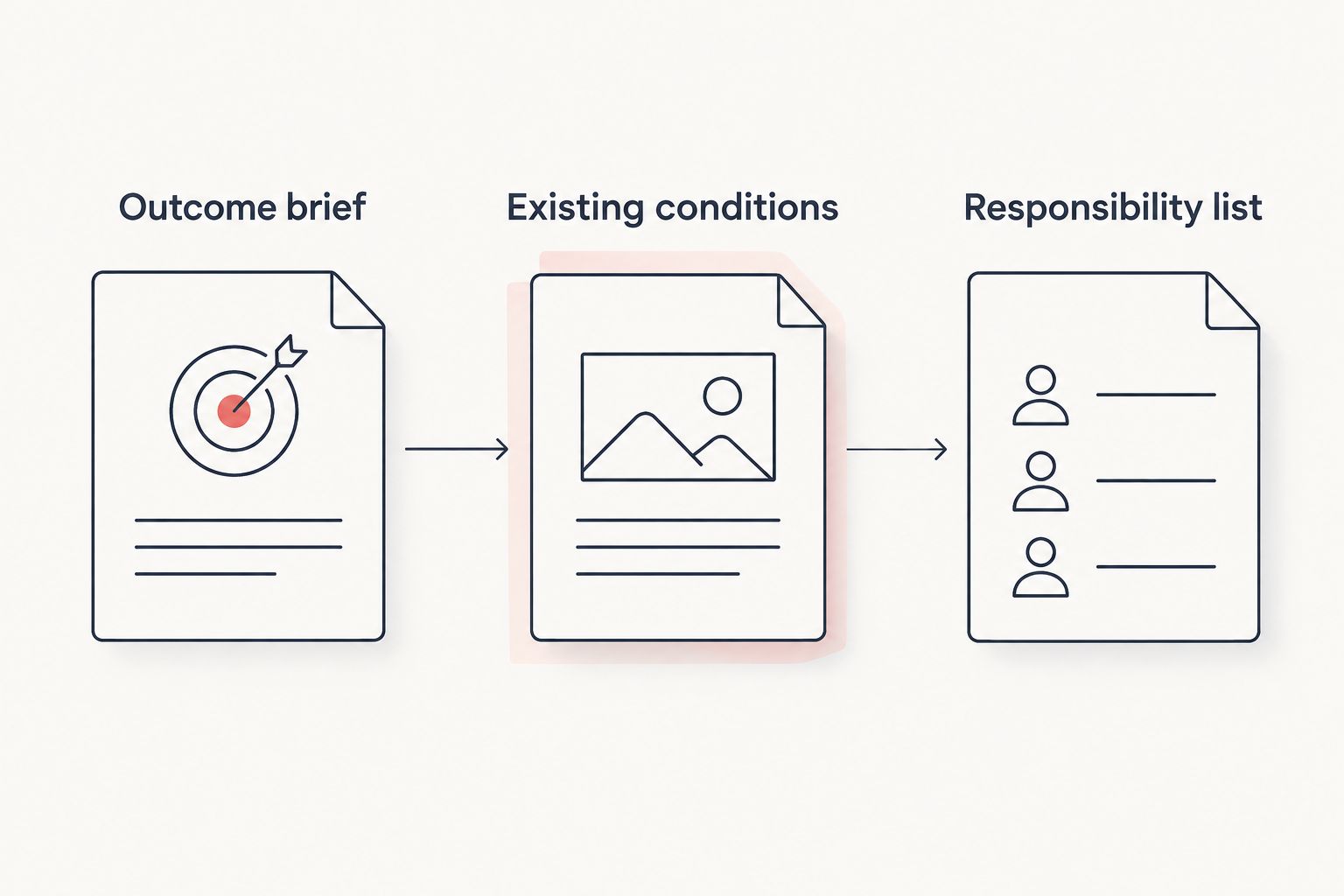
These documents also make changes easier to identify. When your expectations change, revise the brief rather than relying on a conversation that never reaches the written scope.
Verify the company, then compare the agreement
For a 2026 contractor search, separate finding candidates from verifying the business you will hire. Online listings can introduce names, but they do not establish project scope, insurance documentation or who will supervise your property.
The process of finding a remodeling contractor should end with a direct conversation about the actual work, followed by written responsibilities. Ask each candidate the same questions so a confident sales conversation does not substitute for a comparable agreement.
- Who is the contracting entity, and who supervises the job?
- Which parts of the work are included in the estimate?
- Who handles permits and required inspections?
- How are changed conditions documented and approved?
- What protection and cleanup are included?
- What documents define completion and any correction work?
Request references relevant to your project type, then ask about scope management and communication rather than appearance alone. A reference for a small exterior repair does not answer every question about a major interior renovation.
Compare exclusions before comparing totals
Read competing proposals side by side. Mark every item that appears in one agreement but not the other; these differences explain what you are actually comparing.
Review at least 2 proposal versions when your requirements change: the original and the revision. Preserve the original so you can identify added work, removed work and changed assumptions without relying on memory.
Check these categories separately:
- Site work: Access, excavation, grading, drainage and disturbed-ground restoration.
- Building work: Demolition, framing, roofing and changes to existing surfaces.
- Systems: Electrical, plumbing, heating and cooling work affected by the remodel.
- Finishes: Cabinets, flooring, trim, fixtures and painting.
- Closeout: Cleanup, correction items and documents required by the agreement.
Ask whether owner-selected materials are included, excluded or handled through an allowance. Also establish who receives deliveries and checks materials before installation. A written allowance is not the same as an unrestricted selection.
When remodeling becomes a new-building decision
A larger 2026 project deserves a clear comparison between improving the existing building and creating new space. Assess the required layout, existing structure, access and site work before committing to a renovation plan.
For buyers near Bowling Green, that discussion can include a new home, pole-barn garage, workshop, storage barn or commercial pole building. A barndominium with finished living space requires more than a completed exterior shell.
Ayres Construction & Remodeling describes its new-home and barndominium service as full construction from site preparation through finished interiors. Keep that complete scope in the comparison: excavation and concrete belong alongside the interior work, not outside the decision.
Use 1 responsibility list for the whole project, even when the agreement divides construction into phases. Otherwise, a shell, utility connection or finish package can appear complete while the intended building remains unfinished.
Which remodeling option should you choose?
Choose a general contractor when your project connects several trades and you want their responsibilities coordinated in one construction scope. Choose a single-trade contractor when the work has a clean boundary. Manage separate trades only when you accept the coordination role.
For a Bowling Green project, start an estimate conversation with the finished result, property conditions and exclusions you need resolved. Ask Ayres Construction & Remodeling to define the proposed work in writing before you compare it with another agreement.
Request a project estimate
Discuss your Bowling Green remodeling scope, site preparation and finished-project requirements.
FAQ
What's the best way to compare home remodeling companies in Bowling Green?
Compare written responsibilities for the same project scope. Check license and insurance documentation, site preparation, trade coordination, exclusions and change approval before comparing proposal totals.
Should I hire a general contractor or a roofing contractor?
Hire for the scope: a roofing contractor fits isolated roofing work, while a general contractor fits a remodel involving several connected trades. Clarify responsibility for any structural repairs or interior restoration related to the roof work.
Is Ayres Construction & Remodeling local to Bowling Green?
Ayres Construction & Remodeling is based in Bowling Green, Kentucky, and is licensed and insured. Its service area includes Kentucky and southern Indiana.
What should a remodeling estimate include?
A remodeling estimate should define included work, exclusions, material responsibilities and the process for approving changes. Ask who handles permits, site protection, debris removal and final cleanup.
Can I hire separate contractors for each part of a remodel?
You can use separate trade agreements, but you must assign coordination responsibility. Define who checks starting conditions, manages handoffs and resolves work that falls between the contracts.
Does a barndominium construction scope include finished interiors?
A full-construction barndominium scope includes site preparation through finished interiors, not just the shell. Confirm the specific site work, building systems and finishes in the project agreement.
How much will my Bowling Green remodel cost?
Your project estimate must reflect the actual scope and property conditions. Separate included work, allowances, owner purchases and exclusions before treating proposals as directly comparable.
One last thing
Ask every bidder to describe what will still be unfinished when their contract is complete. That question exposes gaps more directly than asking whether they handle everything. Resolve those gaps before signing, not when the next trade arrives.