Best overall for a fence-only project: a dedicated fence installer with a written installation scope. Best for coordinating excavation and broader construction: Ayres Construction & Remodeling, a local, licensed and insured general contractor based in Bowling Green; confirm fence installation separately before including it in your 2026 project.
- Comparing fence companies southern kentucky buyers find starts with installation scope, gate requirements, and site conditions.
- Choose a dedicated fence installer for a standalone boundary, privacy, or enclosure project.
- Ayres Construction & Remodeling fits general contracting and site preparation; confirm fence installation before hiring.
- Use a farm-fencing specialist for livestock containment and a repair-focused installer for isolated damage.
Why this matters
A fence quote is not complete just because it names a material and a total. You need to know who establishes the layout, handles clearing, installs gates, removes debris, and addresses disturbed ground. Otherwise, you are comparing different jobs under the same heading.
This 2026 guide ranks hiring options by project fit, rather than presenting an unsupported league table of named fence companies. The distinction matters: a contractor’s general construction services do not establish that the contractor installs fences.
For buyers planning a new home, pole-barn garage, workshop, or storage barn around Bowling Green, fence placement also affects construction access. Decide how the enclosure fits the building project before accepting an installation layout.
What makes the best fence contractor
Use these criteria before comparing proposals:
- Confirmed installation scope: The proposal identifies fence installation, not just excavation, grading, or material delivery.
- Purpose-matched materials: Privacy, pet containment, livestock control, and property marking require different decisions.
- Written gate details: Opening width, swing direction, hardware, and access requirements appear in the scope.
- Site responsibility: Clearing, utility-location coordination, digging conditions, and cleanup have named owners.
- Clear exclusions: Surveying, permits, demolition, disposal, grading, and restoration are included or excluded explicitly.
- Relevant project evidence: Ask for examples involving the fence type and site conditions you are proposing.
Request 2 written proposals using the same layout and specifications. That is a practical comparison step, not a claim that two bids establish a market average. If the scopes differ, resolve those differences before comparing totals.
Southern Kentucky fence options at a glance
The order below follows project fit: standalone installation first, coordinated construction second, then specialized containment and repairs. It does not represent verified performance rankings of local businesses.
| Hiring option | Best for | Standout capability to confirm | Key limitation |
|---|---|---|---|
| Dedicated fence installer | Standalone residential fencing | Installation, gates, and material-specific details | Major grading or construction can fall outside the scope |
| Ayres Construction & Remodeling | Site preparation tied to broader construction | Excavation, concrete, and general contracting | Fence installation is not established by the stated services |
| Farm-fencing specialist | Livestock and agricultural boundaries | Containment design matched to intended use | Decorative residential work requires separate confirmation |
| Fence repair specialist | Isolated damage to an otherwise usable fence | Diagnosing posts, panels, gates, and hardware | Spot repairs do not resolve widespread deterioration |
1. Dedicated fence installer: best for standalone fencing
A dedicated fence installer is the first hiring option for a project whose main deliverable is the completed fence. Ask the company to specify the proposed system, installation method, gate construction, and responsibility for finishing the site.
Do not treat the phrase fence company as proof of suitability. A residential privacy enclosure and an agricultural boundary involve different layouts, materials, and access requirements.
Dedicated fence installer pros:
- Gives you a fence-specific scope to evaluate.
- Keeps posts, panels, gates, and hardware within one installation discussion.
- Lets you request examples of the particular fence system you want.
Dedicated fence installer cons:
- Substantial excavation or grading needs separate confirmation.
- Building construction, concrete work, and drainage changes are not automatically included.
- Material familiarity must be checked rather than assumed.
Best for: Homeowners who need a standalone privacy fence, yard enclosure, or defined boundary and already understand the intended layout.
Before hiring, ask who makes the final layout decision and what happens if digging exposes unsuitable conditions. The proposal should explain how additional work is authorized, rather than leaving that conversation until installation is underway.
Verdict: Buy this service when the fence scope, site responsibilities, and gate details are written down.
2. Ayres: best for coordinated site preparation
Ayres Construction & Remodeling is the best fit here for buyers seeking a local, licensed and insured general contractor to coordinate site preparation with broader construction. Its stated services include excavation, concrete, new construction, remodeling, and roofing. Those services support a construction-planning discussion; they do not establish a fence-installation offering.
For a 2026 new-home or barndominium project, discuss the complete construction sequence, from site preparation through finished interiors. Then identify where fencing belongs and who will install it. Do not assume a general construction agreement includes the fence.
Ayres Construction & Remodeling pros:
- Is based in Bowling Green, Kentucky.
- Is local, licensed and insured.
- Offers excavation, concrete, and broader construction services relevant to site coordination.
- Serves residential and commercial property owners in Kentucky and southern Indiana.
General-contractor route cons:
- Fence installation requires direct confirmation.
- A standalone fence project does not automatically require broader construction management.
- Boundaries, permits, materials, and gate specifications still need explicit responsibility assignments.
Best for: Property owners combining site preparation with a new home, pole building, workshop, concrete work, or remodeling project.
Ask for a project estimate that separates construction work from any proposed fencing. If another installer handles the fence, identify the handoff: finished grades, access routes, installation timing, and responsibility for repairs to disturbed surfaces.
Verdict: Hold the fence commitment until installation scope is confirmed; request an estimate for the stated construction and site-preparation services.
3. Farm-fencing specialist: best for livestock containment
A farm-fencing specialist is the hiring option to investigate when containment, agricultural access, and long boundary runs drive the project. Start with what the fence must contain or exclude, then discuss the system.
The animal, terrain, gate use, and maintenance plan belong in that conversation. A fence selected for appearance alone is not a complete livestock-containment specification.
Farm-fencing specialist pros:
- Keeps containment requirements central to the design discussion.
- Supports a focused review of gates, corners, bracing, and terrain.
- Helps separate working agricultural access from pedestrian access.
Farm-fencing specialist cons:
- Decorative finishes and residential privacy systems require separate confirmation.
- Agricultural experience does not establish experience with every animal or enclosure type.
- Clearing, drainage crossings, and boundary verification still need written scope.
Best for: Owners planning livestock enclosures, agricultural divisions, or working access around barns and storage buildings.
Explain the intended use before requesting a material recommendation. Also identify where tractors, trailers, and deliveries enter. A gate that suits everyday foot traffic does not necessarily suit equipment access.
Verdict: Buy this service for containment-led projects after the installer addresses the intended animals, terrain, and equipment access.
4. Fence repair specialist: best for isolated damage
A repair-focused installer is the first option to investigate when the problem is limited to a gate, a damaged section, or specific posts. Ask for a diagnosis before agreeing to replacement of the entire fence.
The repair proposal should distinguish failed components from usable components. It should also explain whether the problem comes from hardware, support, alignment, ground conditions, or deterioration.
Fence repair specialist pros:
- Focuses the scope on the identified failure.
- Gives you a way to compare repair against replacement.
- Can separate gate adjustments from structural fence work.
Fence repair specialist cons:
- New components do not necessarily match weathered materials.
- Repairing one location does not correct deterioration elsewhere.
- A visible lean or sag needs diagnosis, not just cosmetic correction.
Best for: Owners with a largely usable fence and a clearly identified problem area.
For a 2026 repair estimate, request an explanation of what stays, what gets replaced, and what remains outside the repair. Do not accept a promise that localized work restores the condition of the entire enclosure.
Verdict: Buy targeted repairs when the remaining fence is serviceable; skip cosmetic fixes that leave the underlying failure unresolved.
Plan the fence around the construction sequence
Fencing around a new home, pole-barn garage, commercial pole building, or workshop needs a site plan that accounts for construction access. Permanent posts and gates should not conflict with the access required to finish the larger project.
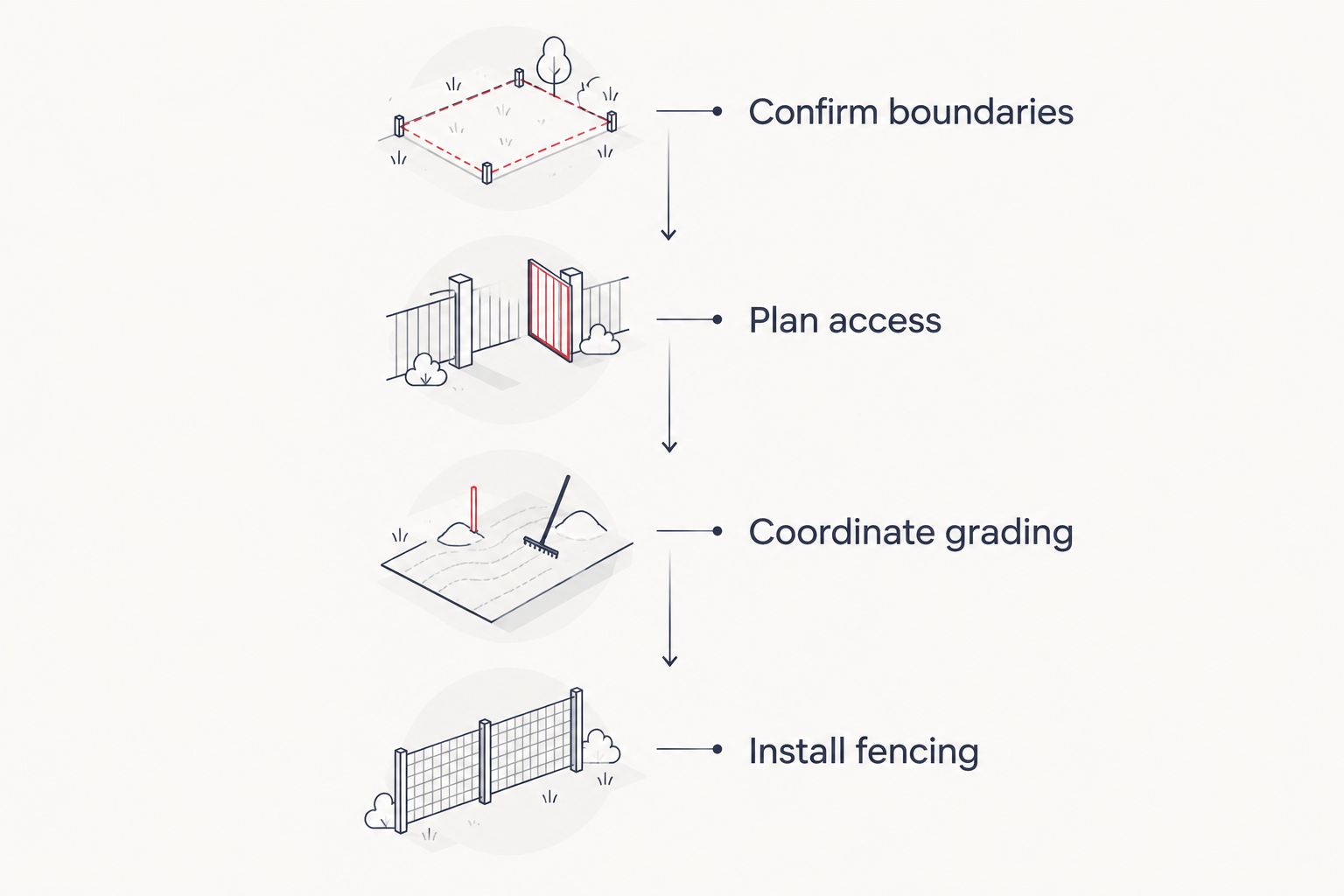
Use this sequence with your contractors:
- Confirm boundaries: Establish the intended fence line and obtain surveying help where boundaries are uncertain.
- Plan access: Identify construction entrances, equipment routes, deliveries, and permanent gates.
- Coordinate grading: Agree on finished ground conditions and drainage responsibilities before final installation details.
- Install fencing: Proceed under the agreed layout, specifications, and responsibility assignments.
Measure 3 gate dimensions during planning: clear opening width, required vertical clearance, and swing clearance. Use your actual vehicles and equipment requirements rather than choosing a gate from appearance alone. Record those requirements in the proposal.
What belongs in your written estimate
For your 2026 project, ask each bidder to use the same drawing and scope. Differences should be visible before you sign, not discovered when one crew arrives expecting another crew to have cleared the site.
The estimate should address:
- Layout: Fence location, endpoints, corners, and gate positions.
- Materials: Fence system, components, finish, and hardware specifications.
- Preparation: Clearing, demolition, grading, and access requirements.
- Ground conditions: How rock, unsuitable soil, or other obstacles change the work.
- Responsibilities: Permits, utility-location coordination, boundary verification, and inspections where required.
- Closeout: Debris removal, disturbed-ground restoration, and written warranty terms if offered.
Keep 1 written scope as the shared reference for the project. Changes should identify the revised work and require your approval. Do not rely on a conversation about an extra gate or relocated corner to serve as the final instruction.
Request a construction project estimate
Discuss excavation, concrete, and broader construction in Kentucky or southern Indiana.
How these options were ranked
The ranking uses the criteria above: confirmed scope, intended use, gate details, site responsibility, exclusions, and relevant project evidence. A dedicated installer comes first for a standalone fence because the required deliverable is fence installation.
The other options solve different problems. General contracting addresses coordinated construction; agricultural specialization addresses containment; repair work addresses localized failures. No review scores, installation totals, or unsupported claims of local market leadership determine the order.
Which fence contractor should you choose?
Choose a dedicated fence installer by default when your project is only a fence. Ask for a material-specific proposal, relevant examples, and a clear allocation of site responsibilities.
Choose the other routes only when the project calls for them. For larger construction around Bowling Green, Ayres Construction & Remodeling belongs in the site-preparation and general-contracting discussion; confirm fencing separately. For livestock containment or isolated damage, start with the corresponding specialist.
FAQ
What's the best type of fence company for a Southern Kentucky home?
A dedicated fence installer is the default choice for a standalone residential fence. Compare written installation scopes, relevant examples, gate details, and site responsibilities before hiring.
Does Ayres Construction & Remodeling install fences?
Confirm fence installation directly before including it in an agreement. The stated services establish general contracting, excavation, concrete, roofing, remodeling, and new construction, not a specific fence-installation offering.
Should I hire a general contractor or a fence installer?
Hire a fence installer for a standalone fence and consider a general contractor when the project also requires coordinated construction or site preparation. Put the division of responsibilities in writing if separate contractors are involved.
What should a fence estimate include?
A fence estimate should identify the layout, materials, gates, preparation, exclusions, and cleanup responsibilities. It should also explain how changed ground conditions and additional work are approved.
Should fencing go in before a new home or pole barn is finished?
Set fence timing around the construction access and grading plan. Agree on equipment routes, permanent gates, and finished ground conditions before installing a fence that could obstruct remaining work.
Is repairing a fence better than replacing it?
Repair is the option to investigate when damage is isolated and the remaining fence is usable. Ask the installer to distinguish localized failure from deterioration affecting the wider enclosure.
What should I check before hiring a fence contractor in 2026?
Check the contractor's relevant experience, insurance documentation, written scope, exclusions, and responsibility for required approvals. Confirm who handles boundary questions and utility-location coordination before digging begins.
One last thing
Before approving the fence line, walk the proposed gate locations as if you were making the largest routine delivery to the property. Include the approach and turning space, not just the opening itself.
A correctly specified fence can still have a poorly placed gate. Resolve that access decision on the layout before posts make it permanent.