Best for concrete within a larger building project: Ayres Construction & Remodeling, a local, licensed and insured general contractor based in Bowling Green, Kentucky, serving southern Indiana. Best for standalone paving: a concrete flatwork specialist. Best for structural work: a foundation contractor. Your 2026 shortlist should follow the work you need, not a contractor’s position in a directory.
- For concrete contractors southern indiana searches, shortlist Ayres Construction & Remodeling for concrete tied to excavation or new construction.
- Choose a flatwork specialist for a standalone driveway, patio or walkway; compare written preparation and drainage specifications.
- Choose a foundation contractor for structural concrete, with engineering and inspection responsibilities defined before construction.
- Compare repair with replacement only after identifying why the existing concrete cracked, settled or deteriorated.
Why this matters
Concrete bids are difficult to compare when one includes excavation, base preparation and debris removal while another covers only forming and placement. The best contractor is the one qualified for your project who puts the complete scope in writing. A short description such as concrete slab leaves too much undecided.
Ayres Construction & Remodeling offers concrete, excavation and new construction services. That combination belongs on your shortlist when concrete is part of a new home, garage, workshop or larger property project—not just an isolated surface replacement.
This 2026 guide compares contractor types by project fit. It is not a customer-review leaderboard or a claim that one company outperforms every concrete business in southern Indiana.
What makes the best concrete contractor?
Use these criteria before comparing proposals:
- Scope fit: Match driveways, foundations, building slabs and repairs to relevant experience. Concrete work is not a single interchangeable service.
- Site preparation: Require an explanation of excavation, unsuitable soil removal, base materials and compaction responsibilities.
- Drainage: Identify surface slopes, downspouts and adjacent grades before approving elevations.
- Written specifications: Require slab dimensions, reinforcement, joints, finish, curing and protection requirements appropriate to the project.
- Credentials and accountability: Confirm applicable licensing, insurance, permits, inspections and responsibility for subcontracted work.
- Contract completeness: Compare exclusions, cleanup, change orders and payment terms alongside the construction scope.
For a 2026 project, ask each bidder to price the same drawings or written description. Different assumptions produce different proposals, even when the finished surfaces initially look similar.
Concrete contractor options at a glance
| Ranked option | Best for | Standout reason to consider | Key limitation |
|---|---|---|---|
| Ayres Construction & Remodeling | Concrete coordinated with excavation and broader construction | Offers concrete, excavation and new construction services | Broader contracting scope does not replace project-specific concrete specifications |
| Concrete flatwork specialist | Standalone driveways, patios and walkways | Focused fit for exterior paving and surface finishes | Foundation work and building coordination require separate confirmation |
| Foundation contractor | Structural footings and foundations | Focused fit for concrete supporting a building | Exterior paving and decorative finishes are separate capabilities to verify |
| Concrete repair specialist | Evaluating an existing damaged surface | Focused fit for repair assessment rather than automatic replacement | Surface repairs do not correct every underlying soil or drainage problem |
The order follows project scope, not independently measured workmanship. Use the table to choose the right category, then evaluate individual contractors against the same requirements.
1. Ayres Construction & Remodeling: best for coordinated construction
Ayres Construction & Remodeling is best for southern Indiana concrete projects that also require excavation or broader building work. The company serves residential and commercial property owners and offers both concrete and new construction services.
For a new home or barndominium, the stated service covers construction from site preparation through finished interiors rather than shell-only work. That makes the relationship between concrete elevations, building layout and later construction central to the hiring decision.
Pros:
- Local, licensed and insured, with a Bowling Green, Kentucky, base.
- Offers excavation and concrete alongside general construction.
- Serves residential and commercial property owners in southern Indiana.
- Provides full construction for new homes and barndominiums.
Cons and scope checks:
- A broader construction proposal needs clear boundaries between site work, concrete and subsequent trades.
- A standalone paving project still needs its own finish, joint and curing specifications.
Best for: Property owners planning a building project where excavation, foundations or slabs must coordinate with other construction work.
For your estimate request, describe the intended building use and the concrete work separately. A garage, workshop, storage barn and finished living space have different planning requirements; the contractor needs that distinction before defining the work.
Verdict: Buy the coordinated-construction approach when your project extends beyond concrete placement; approve only a defined written scope.
2. Concrete flatwork specialist: best for standalone exterior paving
A concrete flatwork specialist is the appropriate category for a driveway, patio or walkway that does not involve a larger building contract. Your comparison should focus on preparation, drainage, surface finish and the details where new concrete meets existing structures.
Ask how the proposed elevations affect garage entrances, door thresholds and adjacent landscaping. A finish sample cannot answer those questions.
Flatwork specialist pros:
- A direct project match for standalone exterior paving.
- A focused basis for discussing finish texture and appearance.
- A clear scope for comparing removal, preparation and replacement bids.
Flatwork specialist cons:
- Flatwork experience alone does not establish structural foundation capability.
- Utility relocation, substantial excavation and landscape restoration need explicit contract coverage.
Best for: Homeowners replacing or adding exterior concrete without coordinating an entire building project.
For a 2026 driveway proposal, define how vehicle access will work during construction and who authorizes reopening the surface. Do not substitute a generic online waiting period for the contractor’s project-specific instructions.
Verdict: Buy a flatwork-focused scope for standalone paving; skip proposals that leave preparation or drainage undefined.
3. Foundation contractor: best for structural concrete
A foundation contractor is the appropriate category when concrete supports a home, garage, workshop or other building. Footings, foundation walls, reinforcement and related details must follow the applicable plans and local requirements.
Distinguish the structural foundation from the interior floor slab. They serve different functions, and the contract should identify which components the contractor is responsible for building.
Foundation contractor pros:
- A direct scope match for concrete supporting a structure.
- A focused discussion of plans, elevations and inspection stages.
- A clear basis for assigning footing and foundation responsibilities.
Foundation contractor cons:
- Structural concrete experience does not establish decorative finishing capability.
- Waterproofing, drainage, backfill and utility penetrations need separate scope confirmation.
Best for: Owners building a new structure or undertaking work that changes structural support.
Before accepting a proposal, identify who supplies the design and who resolves discrepancies between drawings and site conditions. Changes to structural concrete require an approval process, not an informal decision during placement.
Verdict: Buy a foundation-specific scope for structural work; hold approval until design and inspection responsibilities are clear.
4. Concrete repair specialist: best for assessing existing damage
A concrete repair specialist is the appropriate category when you need to determine whether an existing surface can be repaired. Start with the condition and its cause: cracking, settlement, surface deterioration and movement are not interchangeable problems.
A repair proposal should explain what the treatment addresses and what remains unchanged. A surface treatment does not resolve an underlying drainage or support problem simply because the finished surface looks better.
Concrete repair specialist pros:
- Keeps repair in the comparison instead of assuming full replacement.
- Supports a discussion of the damaged area and repair boundaries.
- Helps distinguish appearance concerns from problems requiring further assessment.
Concrete repair specialist cons:
- A visible patch can remain different from surrounding concrete.
- Repair is not a substitute for structural evaluation when movement raises safety concerns.
Best for: Property owners evaluating existing concrete before committing to removal and replacement.
Ask what evidence supports the proposed treatment. If the explanation addresses only the visible crack while ignoring recurring movement or water, request a clearer diagnosis before signing.
Verdict: Hold the repair decision until the cause is understood; skip appearance-only work when the underlying problem remains unresolved.
How to compare concrete proposals in 2026
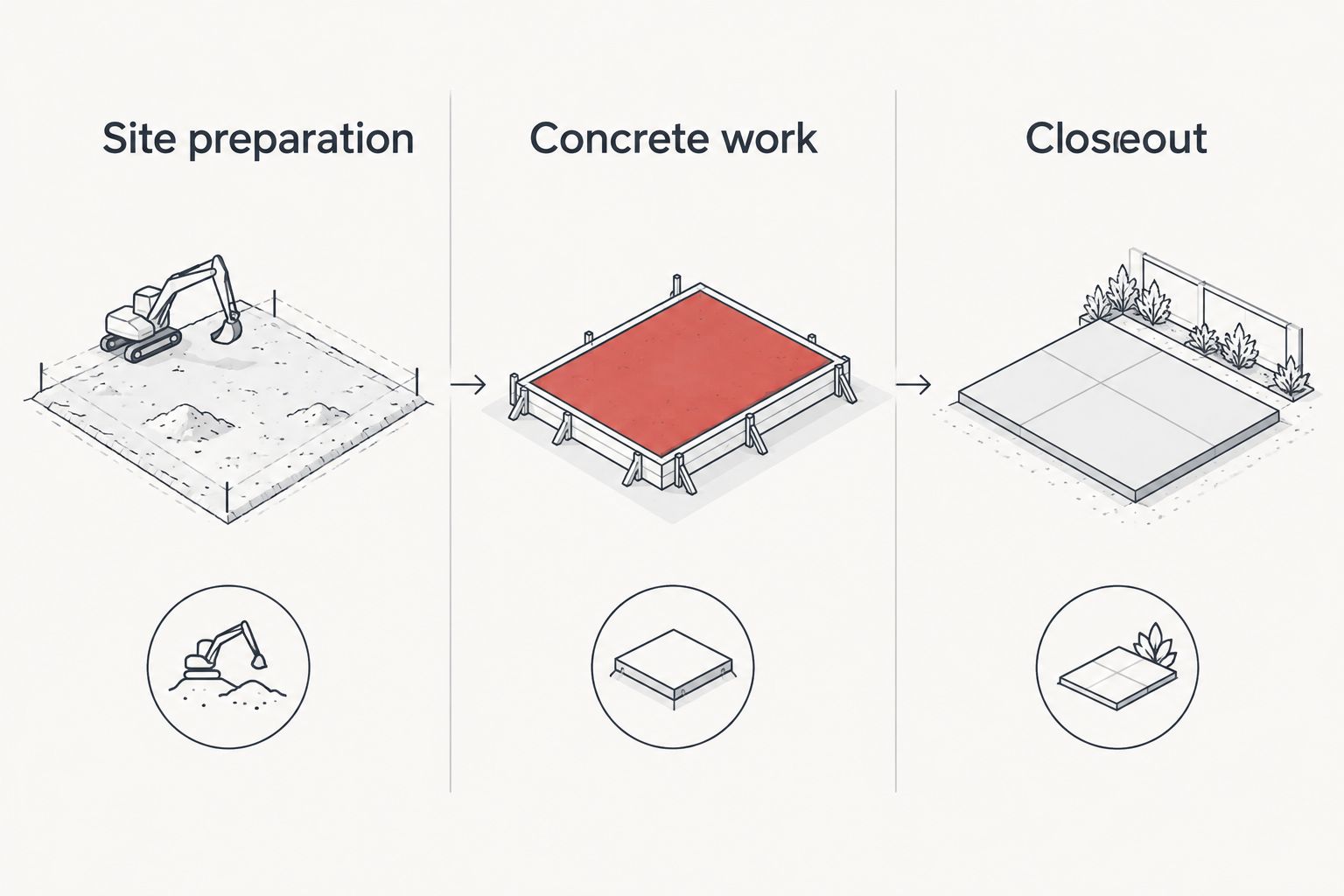
Separate each proposal into site preparation, concrete work and closeout. These are comparison categories, not a prescribed construction sequence. They make it easier to find omitted work without confusing it with a difference in material or workmanship.
Site preparation
Require the proposal to address existing concrete removal, excavation, access and disposal. Identify responsibility for locating utilities before digging and for handling unexpected buried material or unsuitable soil.
For a pole-barn garage or workshop, confirm how the pad relates to surrounding grade and the approach to each overhead door. Door placement, drainage and concrete elevations belong in the same planning conversation.
Concrete work
Ask for dimensions, reinforcement requirements, joint layout, finish and curing provisions in writing. The appropriate specifications depend on design, use and site conditions; a generic thickness copied from another project is not a substitute for that assessment.
Also identify embedded items and penetrations before placement. Building services and floor arrangements need coordination before concrete makes later changes more disruptive.
Closeout
Clarify debris removal, adjacent surface repairs, grading and any landscaping work. Ask for written instructions covering surface protection and return to use.
Keep warranty wording tied to the actual contract. Do not assume that every crack is covered, that all cracking represents failure or that a verbal assurance defines a remedy.
Questions that expose incomplete bids
Ask these questions before comparing the final proposals:
- What work is excluded from this estimate?
- Who handles permits and required inspections?
- What happens if excavation reveals unsuitable material?
- Who approves changes to grade, drainage or reinforcement?
- Which surface finish and joint details are included?
- Who restores areas disturbed outside the concrete footprint?
- How are change orders documented and approved?
For your 2026 shortlist, record each answer beside the relevant contract provision. An answer given during a site visit should appear in the agreement if it affects the work you expect to receive.
Do not choose between incomplete scopes. Resolve the differences first, then compare the remaining proposals on the same basis.
Request a concrete project estimate
Describe your southern Indiana site, concrete scope and any excavation or building work.
How these options were ranked
The ranking prioritizes scope fit, preparation, drainage, written specifications and responsibility for connected work. Ayres Construction & Remodeling appears first for integrated construction because its stated services include concrete, excavation and new construction.
The specialist categories serve narrower decisions. They are not named business endorsements, and the order does not imply verified differences in customer satisfaction or workmanship.
Which concrete contractor should you choose?
Choose the contractor category that matches the entire job. For a new home, barndominium or pole-building project, begin with a contractor able to coordinate site preparation and construction. For an isolated driveway, begin with flatwork specialists.
For structural work, require the applicable design and inspection process. For damaged existing concrete, establish the cause before selecting repair or replacement. Those distinctions are more useful than an unsupported regional winner.
FAQ
Who should I shortlist for concrete work in southern Indiana?
Shortlist Ayres Construction & Remodeling when concrete is part of excavation or a larger construction project. For standalone paving, structural foundations or repairs, compare contractors whose documented experience matches that specific scope.
Is a general contractor better than a concrete specialist?
A general contractor is the better fit when concrete must coordinate with broader construction responsibilities. A concrete specialist is the more focused category for a clearly defined standalone job; compare the actual scope rather than the business label.
What should a concrete estimate include?
A concrete estimate should define preparation, dimensions, materials, reinforcement requirements, joints, finish, curing, cleanup and exclusions. It should also identify responsibility for permits, inspections and changes caused by unexpected site conditions.
Should I repair or replace a cracked concrete driveway?
Base the repair-or-replacement decision on the cause and extent of the damage. Recurring movement, drainage problems and surface deterioration require different responses, so request an assessment before choosing a treatment.
Does a pole-barn slab need planning before construction?
Yes, plan a pole-barn slab with the building layout, intended use, door locations and site drainage. Confirm the foundation and slab requirements with the responsible designer and contractor before placement.
Can Ayres handle more than the concrete portion of a project?
Ayres Construction & Remodeling offers excavation, concrete and new construction services. Its new-home and barndominium service covers construction from site preparation through finished interiors; define the included work in your project estimate.
What should I check before hiring a concrete contractor in 2026?
Check applicable licensing, insurance, relevant project experience and the written construction scope. Confirm permit responsibilities and compare exclusions before approving the agreement.
One last thing
Approve drainage and finished elevations before approving the surface finish. A finish choice changes how concrete looks; elevations determine how it meets doors, surrounding ground and connecting surfaces.
Bring those details to the estimate discussion, especially for a garage or workshop. The most useful proposal explains not only what gets poured, but how the concrete fits the property and the building.