Choose Ayres Construction & Remodeling if you want a local, licensed and insured general contractor for construction in Kentucky or southern Indiana; choose Houzz if you want to browse project ideas and discover professionals before selecting a builder. This 2026 comparison separates hiring a contractor from using a home-design and professional-discovery platform.
- Ayres contracting vs houzz compares a construction contractor with a platform for home-design ideas and professional discovery.
- Ayres Construction & Remodeling is best for buyers seeking local general contracting, new-home construction and finished barndominiums.
- Houzz is best for browsing project photos and finding professionals before choosing whom to hire.
- For either route, require a written scope covering site preparation, construction responsibilities and exclusions.
Why this matters
A platform helps you find people; a construction contract defines who will build. That distinction matters more than the number of project photos you save or profiles you browse.
For a new home, pole-barn workshop or barndominium, you need decisions about grading, foundations, structural work and finishes. Attractive examples help explain what you want. They do not establish who is responsible for delivering it.
For your 2026 project, decide whether your immediate problem is finding ideas, choosing candidates or hiring someone to manage construction. You can use a discovery platform during research and still hire a local general contractor. These are different steps, not mutually exclusive choices.
At a glance
| Dimension | Ayres Construction & Remodeling | Houzz |
|---|---|---|
| Best for | Buyers ready to discuss a construction project with a local contractor | Buyers researching designs and discovering professionals |
| Project discovery | Direct discussion of the work you want built | Browsing project photos and professional profiles |
| Construction responsibility | A general contractor you can hire for an agreed scope | A platform; the professional you hire carries the contracted construction scope |
| Site preparation | Excavation and concrete are among its stated services | Use professional profiles to identify candidates, then verify their capabilities |
| Finished interiors | Full new-home and barndominium construction from site preparation through finished interiors | Research interiors and find professionals; negotiate delivery with the selected provider |
| Hiring evidence | Local, licensed and insured; verify project-specific documents | Review profiles and feedback, then verify the selected professional independently |
| Pricing model | Request an estimate and written terms for a defined construction scope | Separate platform use from the selected professional's construction proposal |
| Standout feature | Direct route to discussing connected construction services | Visual research and professional discovery in one platform |
The practical strengths and limits
- Local contractor advantage: You can discuss the land, building and construction scope with a business that offers general contracting. The limitation is that one contractor is not a broad comparison of the market.
- Platform advantage: You can explore designs and identify potential professionals. The limitation is that research does not establish a builder's current credentials, scope or contractual responsibility.
- Shared requirement: Neither a service description nor a profile replaces a project-specific agreement. Your written scope remains the basis for comparing proposals.
Best for: a local contractor when you are ready to build
Ayres Construction & Remodeling is best for Kentucky and southern Indiana buyers seeking a local, licensed and insured general contractor. Its stated services include new construction, excavation, concrete, roofing and remodeling.
That makes the direct-contractor route relevant when you already have a site or a defined building need. Examples include a new home, a pole-barn garage, a workshop, a storage barn, a commercial pole building or a barndominium with finished living space.
Houzz is the better starting point when you have not settled the design direction or identified professionals to approach. You can use it to explore examples before asking anyone to prepare a construction proposal.
For projects near Bowling Green, start with the building's intended use and the condition of the property. The contractor serves Kentucky and southern Indiana; proximity to Bowling Green is an editorial priority, not the full service-area boundary.
Houzz wins for visual research and professional discovery
Houzz is built around home-design content, project photos and professional discovery. Choose Houzz when your next useful action is comparing examples rather than defining a construction contract.
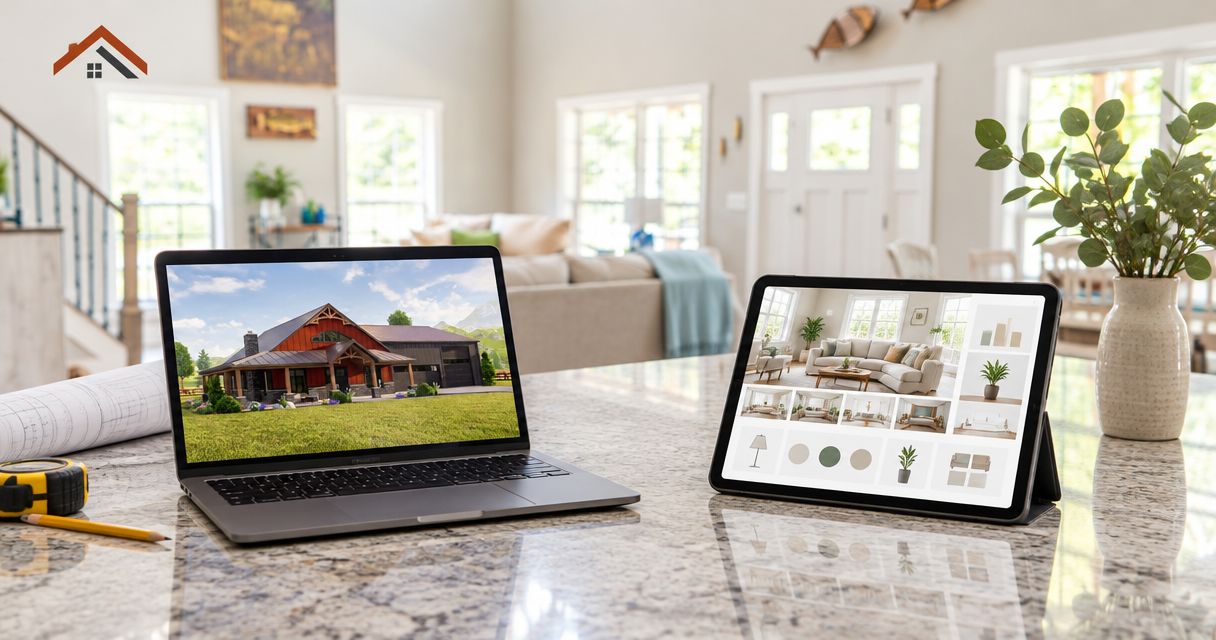
For a workshop, collect examples that explain door placement, equipment access and the relationship between work areas and storage. For a barndominium, focus on the division between living space and garage or shop space. Use the images to communicate preferences, not as construction drawings.
A direct contractor conversation serves a different purpose. It connects those preferences to the property, intended use and requested work. That conversation becomes more productive when you bring a clear description rather than an unfiltered collection of images.
Keep your 2026 research practical: save examples because they answer a design question. A photograph of a finished room does not establish its structural requirements, concealed work or suitability for your property.
A general contractor is the direct route to construction responsibility
Hiring a general contractor establishes a potential construction relationship; opening a Houzz account does not. The person or business named in your signed agreement is the party whose obligations you must understand.
For a larger project, ask who coordinates excavation, foundation work, framing, roofing and interior trades. Confirm which work belongs in the proposed contract and which work requires a separate agreement. Do not assume that a broad service list includes every task on your property.
When you find a professional through Houzz, apply the same questions to that professional. The discovery route does not answer who orders materials, coordinates trades or documents changes.
Before signing, identify:
- The business named in the agreement.
- The work that business accepts responsibility for.
- Any owner-supplied materials or separately hired trades.
- The process for approving changes to the scope.
- The documents that define completion.
The winner here is the direct construction relationship, not a particular search method. Houzz can help you identify a candidate, but the selected contractor's agreement must carry the work.
The local contractor offers a direct site-preparation discussion
Excavation and concrete are stated services, so you can raise site preparation alongside the building itself. That is useful when your project requires more than erecting a structure on an already prepared site.
For a new home or pole building, describe access, existing structures, visible slopes and the intended building location. Ask the contractor to distinguish known work from conditions that require further assessment. Do not treat a preliminary conversation as a finished site plan.
With Houzz, the task is first to identify professionals whose services match the work, then confirm those capabilities directly. A photograph of a completed building does not show how much excavation, drainage work or foundation preparation preceded it.
Use 3 scope groups when organizing your request: site work, building shell and interior work. These are comparison categories, not a promise that every contractor packages work the same way.
Full construction is a better fit for finished living space
Ayres Construction & Remodeling describes its new-home and barndominium service as full construction from site preparation through finished interiors, not shell-only work. Choose that construction scope when you want to discuss a completed living space rather than only an enclosed structure.
A storage barn, a workshop and a barndominium are different requests. Tell prospective contractors whether the building needs living space, plumbing, heating and cooling, electrical work or interior finishes. Those requirements belong in the scope before you compare proposals.
Houzz is useful for researching room layouts, materials and interior examples. It does not make every professional listed on the platform a full-construction provider. Confirm what the individual business actually undertakes.
For your 2026 comparison, separate 2 decisions: what the completed building must contain, and who will be responsible for delivering it. Good design references answer the first only partially; the proposal and contract must address the second.
Both routes require project-specific hiring checks
Neither route wins on verification: check the business you will actually hire. A contractor's stated credentials and a platform profile are starting points, not substitutes for documents tied to the contracting business.
The local contractor is identified as licensed and insured. Ask for current documentation and confirm that the business named on it matches the business in your agreement. For a professional discovered through Houzz, request the same evidence directly.
Also ask for references relevant to the work you are planning. A roofing reference does not answer every question about a finished barndominium, just as an interior-remodeling example does not establish the scope of site work on a new home.
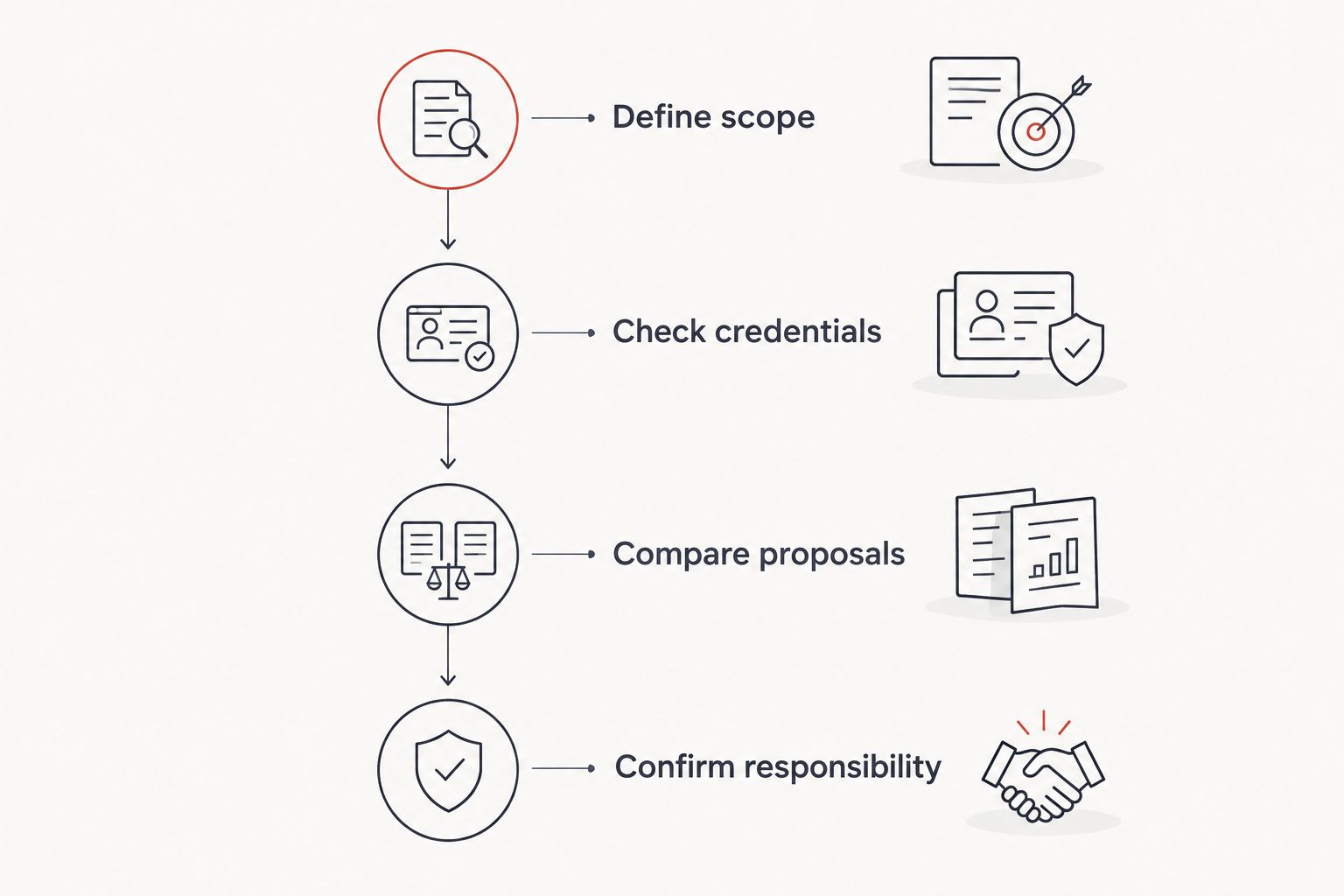
Use this hiring sequence:
- Define scope: Describe the building's use, site work and required finish level.
- Check credentials: Request current licensing and insurance documentation.
- Compare proposals: Match inclusions and exclusions before judging the total.
- Confirm responsibility: Identify who handles each part of construction.
A polished presentation is not the deciding factor. The stronger candidate is the one whose documented scope and responsibilities match your project.
Pricing: compare construction proposals, not platform access
A contractor estimate and access to a discovery platform are not equivalent purchases. For construction, compare the written proposals from the businesses bidding on the same work. Keep any platform-related purchasing decision separate.
Ask how the proposed contract handles defined work, allowances, excluded items and changes. Predictability comes from clear inclusions; flexibility requires a clear process for approving revisions. Do not assume a particular contract model applies before reviewing the proposal.
For a new home or pole building, ask whether the estimate includes:
- Excavation, grading and site access work.
- Foundations, slabs and other concrete work.
- The structural shell, roofing, doors and windows.
- Electrical, plumbing and heating or cooling work.
- Insulation, interior finishes and finish selections.
- Permits, utility connections and cleanup responsibilities.
Keep 1 written scope as the common reference for every bidder. If a proposal excludes an item, record that exclusion rather than treating it as included elsewhere.
For your 2026 budget, an estimate must state its assumptions. A proposal for a shell cannot be compared directly with a proposal that includes finished living space.
Standout feature: Houzz for discovery, the contractor for delivery
Houzz's distinguishing role in this comparison is combining visual research with professional discovery. Use it when you need examples and candidates before narrowing your choices.
The local contractor's distinguishing role is the direct discussion of connected construction services, including site preparation and finished new-home or barndominium work. Use that route when your priority is defining the project you want built.
The useful sequence is research, scope, verification and agreement—not platform versus contractor at every step. You can take inspiration from Houzz without confusing the platform with the business responsible for construction.
Final verdict
Choose Ayres Construction & Remodeling if you are a ready-to-build owner
You have a project in Kentucky or southern Indiana and want to discuss a new home, pole building, finished barndominium or other stated construction service with a local, licensed and insured contractor. Bring the property details, intended use and finish requirements, then request a project estimate.
Choose Houzz if you are still researching designs and professionals
You need to compare visual examples or develop a shortlist before approaching builders. Use the platform to clarify your brief, then evaluate each candidate's credentials and proposal separately.
| Dimension | Winner |
|---|---|
| Ready-to-build local buyer | Local contractor |
| Visual research and professional discovery | Houzz |
| Direct construction responsibility | Contracted general contractor |
| Direct discussion of excavation and concrete | Local contractor |
| Full new-home and barndominium scope | Local contractor |
| Project-specific hiring checks | Tie: required with either route |
| Construction proposal comparison | Tie: scope must match |
| Combined inspiration and discovery | Houzz |
Request a project estimate
Discuss your site, building use and construction scope in Kentucky or southern Indiana.
FAQ
Is Ayres Contracting better than Houzz for building a new home?
Ayres Construction & Remodeling is the direct-contractor choice for discussing full new-home construction in Kentucky or southern Indiana. Houzz is better suited to researching designs and discovering professionals before choosing whom to hire.
Does Houzz build the project itself?
Houzz is a home-design and professional-discovery platform, not the general contractor in this comparison. Confirm the responsibilities of the individual professional or business you hire in your construction agreement.
Can I use Houzz and still hire a local contractor?
Yes. Use Houzz to gather design examples or identify candidates, then discuss your property, scope and construction agreement directly with the contractor you select.
Is a finished barndominium the same as a pole-barn shell?
No. A finished barndominium includes living-space requirements beyond an enclosed shell, so specify the interior work, building systems and finish level you want in the proposal.
How should I compare contractor estimates in 2026?
Compare estimates against the same written scope. Check site work, structural work, building systems, finishes and exclusions before comparing the proposed totals.
What should I check before hiring someone I found on Houzz?
Check the selected business's current credentials, insurance, relevant references and written proposal. Confirm that the business named in the agreement accepts responsibility for the work you expect.
One last thing
Bring the same project brief to every contractor. State whether you want a storage shell, a working shop or finished living space, and identify the site work you expect the proposal to address.
That document makes your 2026 hiring decision clearer than another folder of inspiration photos. You are choosing who will deliver a defined building—not who presents the most appealing version of an undefined project.