
Choose Ayres Construction & Remodeling if you want a local, licensed and insured general contractor for a defined construction project in Kentucky or southern Indiana; choose HomeAdvisor if you want a contractor-search marketplace to identify candidates before deciding whom to hire. The difference in 2026 is direct construction contracting versus contractor discovery—not competing versions of the same service.
- Ayres Contracting vs HomeAdvisor compares a direct general contractor with a contractor-search marketplace.
- Ayres Construction & Remodeling fits buyers seeking full new-home or barndominium construction, from site preparation through finished interiors.
- HomeAdvisor fits buyers who need to identify contractors before requesting project proposals.
- Compare written scopes, exclusions and payment terms—not a contractor’s proposal against a marketplace listing.
Why this matters
A contractor and a contractor-search marketplace solve different hiring problems. A general contractor can price and undertake construction work under an agreed contract. A marketplace helps you find businesses to evaluate; finding a business does not establish the scope, price or responsibility for your project.
That distinction matters when you are planning a new home, pole-barn garage, workshop or barndominium. Excavation, grading, concrete, roofing and interior work need defined responsibilities. A search result is the beginning of that discussion, not the construction agreement.
Ayres Construction & Remodeling is the better fit for buyers seeking a local general contractor rather than a contractor-search platform. HomeAdvisor is the better starting point when your immediate problem is finding contractors to consider.
At a glance
| Dimension | Ayres Construction & Remodeling | HomeAdvisor |
|---|---|---|
| Best for | Buyers ready to discuss a defined construction project | Buyers building a contractor shortlist |
| Hiring relationship | Direct discussion with the construction business | Marketplace search followed by contractor evaluation |
| Scope coordination | General contracting for an agreed construction scope | Discovery of businesses to ask about that scope |
| Contractor discovery | Evaluation of one identified local contractor | Finding contractors to consider |
| Comparison shopping | A project proposal to compare with other proposals | An earlier starting point for identifying comparison candidates |
| Project accountability | Responsibilities established in the construction agreement | Search does not replace an agreement with the selected contractor |
| Standout feature | Full new-home and barndominium construction, including finished interiors | Contractor discovery rather than construction delivery |
| Pricing model | Project-specific construction proposal | Separate marketplace-related terms and contractor proposal terms to review |
Best for: direct contracting wins once your project is defined
The local contractor wins when you are ready to discuss the work, not just search for names. A buyer with a building site, intended use and basic scope can move directly into questions about site preparation, materials and construction responsibilities.
For example, a pole-barn workshop needs more definition than the building footprint. You need to establish how vehicles enter, where equipment sits, whether the space needs plumbing and which interior work belongs in the contract. Starting that conversation with a general contractor addresses the construction decision itself.
HomeAdvisor wins at the earlier stage. If you have not identified any contractors, a marketplace addresses that discovery problem without requiring you to begin with one particular business.
The tradeoff is straightforward: direct contact narrows the conversation immediately, while marketplace discovery gives you candidates who still need evaluation. Neither route removes the need to check whether a contractor fits your specific project.
Hiring relationship: both routes need the same written agreement
Both routes are equal on the need for a written construction contract. Contacting a contractor directly does not make verbal promises sufficient, and finding a contractor through HomeAdvisor does not make the marketplace search your construction agreement.
Before hiring, establish which business will sign the contract, who will communicate with you and how changes will be approved. Ask who handles subcontractor coordination and which responsibilities remain yours.
Keep 3 documents aligned: the written scope, the drawings or specifications, and the payment schedule. Conflicts between those documents create unanswered questions even when each looks reasonable by itself.
For your 2026 hiring decision, treat the route used to find a contractor as separate from the agreement used to hire one. The contract should describe the work you are buying without relying on a listing, conversation or remembered promise.
Scope coordination: the general contractor wins for connected work
A direct general-contractor relationship is the better fit for coordinating connected construction work. New-home and barndominium construction involves decisions that cross trade boundaries, from site preparation through finished interiors.
Ayres Construction & Remodeling provides full new-home and barndominium construction rather than shell-only work. That distinction matters when you want to discuss the building and its finished use together, instead of treating the exterior structure as the whole project.
A pole-barn garage or storage barn still needs a clear division of work. Ask whether your proposal includes:
- Site preparation: clearing, excavation, grading and access work.
- Concrete: the specified foundation or slab and associated preparation.
- Building shell: structural materials, roofing, siding, doors and windows.
- Finished interiors: insulation, interior finishes and applicable trade work.
Those are scope questions, not automatic inclusions. Each item belongs in the written proposal if you expect the contractor to provide it.
HomeAdvisor helps with finding candidates, but contractor discovery does not itself coordinate these work packages. The selected business must explain how it will manage them.
Contractor discovery: HomeAdvisor wins for finding candidates
HomeAdvisor wins when your immediate task is identifying contractors to evaluate. That is the marketplace’s role, whereas a direct contractor conversation focuses on one business and its proposed work.
This is a genuine advantage if your project is still loosely defined or you want to identify alternatives before discussing a contract. You can use the discovery stage to determine which businesses merit a detailed conversation.
The limitation is that discovery does not answer the hiring questions for you. A business name or profile does not establish whether that contractor accepts your location, handles your intended building type or will include the work you expect.
Use the same screening questions for every candidate:
- Does the business handle this project type?
- Does it serve the project address?
- What scope can it undertake directly?
- What information does it need before preparing a proposal?
- Who would manage the construction agreement?
The direct route has the opposite tradeoff. It gets you into a project discussion sooner, but evaluating one contractor is not the same as comparing several candidates.
Comparison shopping: HomeAdvisor wins at the shortlist stage
HomeAdvisor is the better starting point for assembling a shortlist; neither route wins automatically on proposal quality. A marketplace can help you identify businesses, but you still need comparable written proposals before making a construction decision.
Request at least 2 written estimates against the same scope. This is a buying recommendation, not a claim that two proposals guarantee the right result. The purpose is to expose differences in what each business includes, excludes or leaves undefined.
For a 2026 pole-building project, settle the intended use before requesting those estimates. A storage barn, commercial pole building and barndominium with finished living space are not interchangeable briefs. Their proposed work must reflect the use you actually intend.
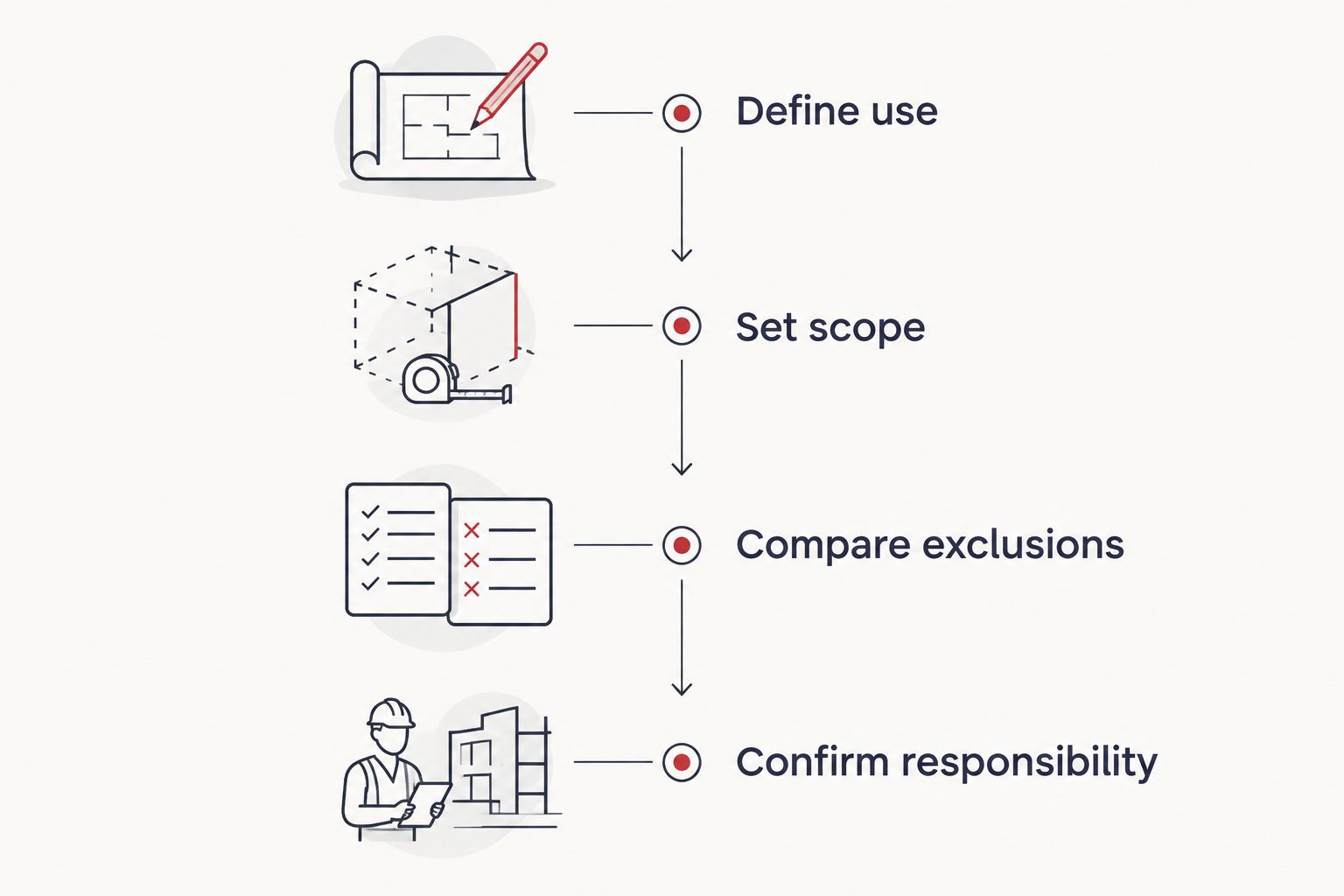
Use this sequence to keep comparison shopping tied to construction decisions:
- Define use: state what the finished building must accommodate.
- Set scope: identify site work, structure and interior requirements.
- Compare exclusions: mark work left outside each proposal.
- Confirm responsibility: identify who supplies or arranges excluded work.
A detailed proposal is useful only when it answers your actual brief. Do not reward a longer document if the excavation, concrete or finished-interior responsibilities remain unclear.
Project accountability: the written scope decides the winner
Neither a direct introduction nor a marketplace introduction wins on accountability by itself. Accountability comes from identifying the contracting business and recording its obligations clearly.
For larger projects near Bowling Green, start with the site and intended building, then ask who owns each part of the work. Kentucky and southern Indiana are the service area; confirm your specific project address rather than assuming coverage from distance alone.
A new-home proposal should distinguish construction work from owner responsibilities. A pole-barn proposal should do the same for access, grading, concrete, building materials and any interior finish work. If fencing is part of your broader property plan, establish whether it belongs in this contract or requires a separate arrangement.
The same principle applies when comparing hiring advice across locations. The contract questions involved in hiring a general contractor in Pittsburgh—scope, exclusions and responsibility—also belong in your Kentucky or southern Indiana contractor interviews; local permitting requirements must be checked separately.
For a 2026 contract, ask how the business documents changes after work begins. A different door opening, added concrete area or revised interior finish should not remain a casual conversation. Get the resulting scope and payment changes in writing before authorizing the work.
Standout feature: finished construction beats discovery for delivery
Full construction is the decisive advantage when your goal is a finished building rather than a list of candidates. Ayres Construction & Remodeling offers new-home and barndominium construction from site preparation through finished interiors.
That service scope gives you a direct reason to discuss a larger project. It does not mean every task is included in every proposal, or that a particular specification is standard. You still need the written scope to identify materials, finishes and exclusions.
HomeAdvisor’s distinct advantage remains discovery. It is the better fit for the buyer whose next action is finding businesses, not deciding construction details with an identified general contractor.
These strengths are not contradictory. You can use a marketplace to identify candidates and then assess each candidate through direct discussions. What matters is recognizing when the search stage ends and the construction evaluation begins.
For roofing, concrete, decking or remodeling work, use the same distinction. Define the actual work before comparing businesses, and do not assume a contractor’s broader service list describes the contents of your individual proposal.
Pricing: compare construction proposals, not search routes
Neither route wins on construction pricing without comparable proposals. A project-specific contractor estimate and the terms associated with using a marketplace address different transactions.
For direct contracting, ask how the proposed agreement handles defined work, allowances, exclusions and changes. A clear scope makes the commitment easier to understand. Undefined selections or unresolved site work leave decisions that still need pricing and approval.
For the marketplace route, review any applicable platform terms separately from the selected contractor’s proposal. Establish what you are agreeing to at each stage. Do not treat a marketplace interaction as confirmation of a contractor’s final construction terms.
Before accepting a 2026 estimate, separate these budget questions:
- Is excavation included, and what site conditions are assumed?
- Are concrete preparation and the specified slab or foundation included?
- Are permits and inspections assigned to a named party?
- Are utility connections included or excluded?
- Are interior selections defined, allowed for or left outside the proposal?
- Are final grading and cleanup included?
The tradeoff is predictability versus unresolved choices—not a guaranteed saving from either hiring route. Choose the proposal that makes the work and remaining obligations clear. A total without that explanation is not a complete basis for hiring.
Final verdict: choose the route that matches your next decision
Choose the local contractor if you are ready to plan construction
Winner: Ayres Construction & Remodeling. You are a Kentucky or southern Indiana property owner with a new-home, pole-building, barndominium or other defined construction project. You want to speak directly with a local, licensed and insured general contractor about site preparation, materials and finished scope.
Bring your project address, intended use, drawings if available and a list of work you expect included. Request a project estimate that distinguishes construction responsibilities from owner-supplied work.
Choose HomeAdvisor if you still need contractors to evaluate
Winner: HomeAdvisor. You are an early-stage buyer without a contractor shortlist, and your immediate goal is identifying businesses to interview. You are prepared to screen those businesses and compare their written proposals afterward.
Do not stop at finding a candidate. Move from discovery to a documented scope before deciding whom to hire.
| Dimension | Winner |
|---|---|
| Best for a defined construction project | Direct local contractor |
| Hiring relationship and written agreement | Tie: both require a clear contract |
| Coordination of connected construction work | Direct general contractor |
| Contractor discovery | HomeAdvisor |
| Building a comparison shortlist | HomeAdvisor |
| Project accountability | Tie: written obligations decide |
| Delivery through finished interiors | Direct general contractor |
| Construction pricing | Tie: compare equivalent proposals |
FAQ
Is Ayres Contracting better than HomeAdvisor?
Ayres Construction & Remodeling is the better fit for direct general contracting in Kentucky or southern Indiana; HomeAdvisor is the better fit for finding contractors to evaluate. The choice is between discussing construction with an identified business and starting a contractor search.
Is HomeAdvisor the contractor that builds my project?
HomeAdvisor is a contractor-search marketplace, not the construction business undertaking your project. Identify the contractor that will sign your agreement and document its responsibilities before hiring.
Which option is better for a new home or barndominium?
Direct discussion with a general contractor is the better next step when you have a defined new-home or barndominium project. Confirm that the proposal covers the required work from site preparation through finished interiors rather than assuming a shell includes everything.
Can I use HomeAdvisor and still compare a direct contractor estimate?
Yes, you can compare contractors found through different routes. Give each business the same project brief and compare written scope, exclusions and payment terms.
Does a pole-barn quote include concrete and interior work?
Only the written proposal establishes whether concrete and interior work are included. Identify site preparation, slab or foundation work, the building shell and interior finishes separately.
How do I compare construction costs in 2026?
Compare written proposals for the same building and work scope. Review allowances, exclusions, utility work and change terms before judging the totals.
Does the contractor serve my project location?
Confirm your specific project address before requesting a detailed proposal. The stated service area is Kentucky and southern Indiana, and location alone does not establish acceptance of an individual project.
One last thing
Ask every contractor: What must I arrange separately before this building is ready for its intended use? That question brings exclusions into the discussion before they become your responsibility on an active job.
For your 2026 project, attach the answer to the proposal. Then request an estimate based on the building you intend to use—not just the structure you can see.