
Choose Ayres Construction & Remodeling if you want a local, licensed and insured general contractor for construction in Kentucky or southern Indiana; choose Angi if you want a marketplace for finding and comparing service providers. This 2026 comparison separates hiring a contractor directly from using a platform to identify candidates.
- Ayres Contracting vs Angi compares a local general contractor with a service-provider marketplace, not two construction companies.
- Ayres Construction & Remodeling is the direct-hire choice for full new-home and barndominium construction in its service area.
- Angi is best for finding contractor candidates before choosing who will perform the work.
- Compare written scopes, insurance documentation and exclusions before comparing project estimates.
Why this matters
A contractor and a contractor marketplace solve different problems. One performs construction under an agreed scope; the other helps you find businesses to consider hiring. Confusing those roles leaves the most important question unanswered: who will actually manage your project?
For a new home, pole-barn workshop or barndominium around Bowling Green, start with responsibility for the entire build. Roofing, concrete, excavation and finished interiors need a defined scope, even when different trades perform the work.
Choose the hiring route first, then compare the businesses responsible for construction. A marketplace profile is not a substitute for a construction contract, and a direct contractor still needs to document what the estimate includes.
At a glance
| Dimension | Ayres Construction & Remodeling | Angi |
|---|---|---|
| Best for | Hiring a local general contractor directly | Finding and comparing service-provider candidates |
| Provider choice | Evaluating one named construction business | Exploring different businesses through a marketplace |
| Standout feature | A direct construction relationship | Contractor discovery |
| Full-build scope | New-home and barndominium construction from site preparation through finished interiors | Scope depends on the contractor you select |
| Site preparation | Offers excavation and concrete services | Requires selecting a provider with the needed capabilities |
| Project accountability | A named contractor whose responsibilities belong in your agreement | Identify the selected contractor and its responsibilities before signing |
| Credential checks | Review license, insurance and project documentation | Review the selected provider's license, insurance and project documentation |
| Pricing model | Request a project-specific construction estimate | Obtain and compare the selected providers' project estimates |
Direct hiring fits a defined local project
The direct-contractor route is best for an owner ready to discuss a specific build. You can start with your property, intended use and required finish level rather than beginning with a broad search for providers.
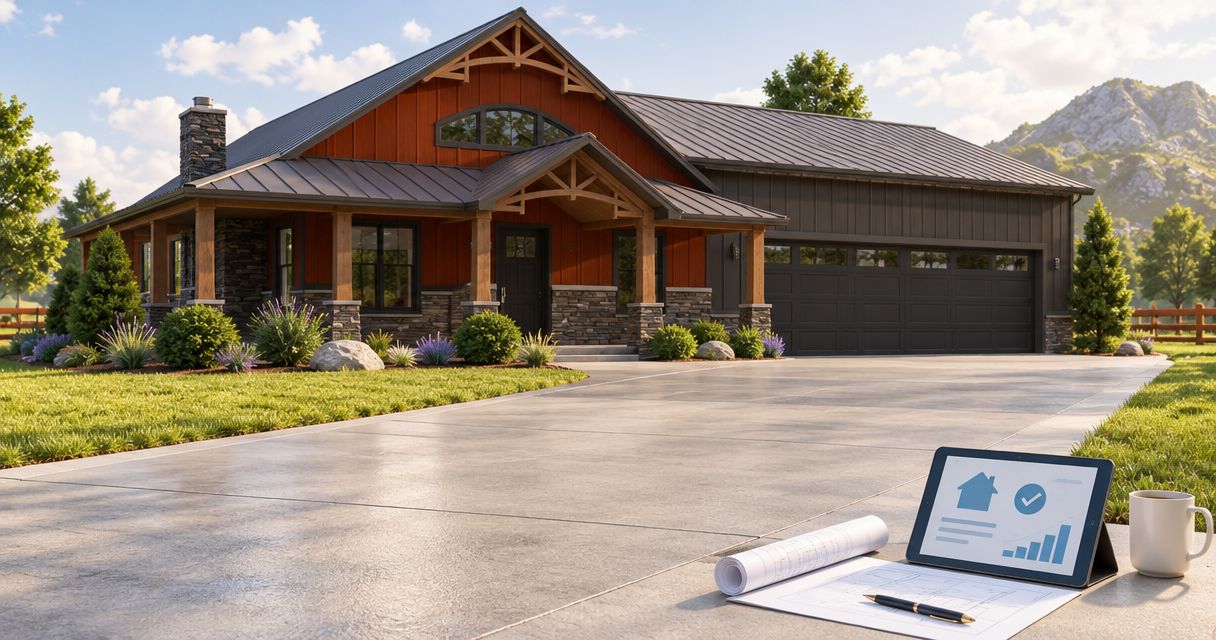
Ayres Construction & Remodeling serves Kentucky and southern Indiana from Bowling Green, Kentucky. Its new-home and barndominium service covers full construction from site preparation through finished interiors, rather than shell-only work.
That makes the direct route relevant when your decision involves more than choosing a building exterior. You need someone to discuss excavation, concrete, the structure and the work required to make the interior usable.
The limitation is equally clear: a direct inquiry evaluates one business. It does not replace comparing qualifications or obtaining another estimate when you want a separate view of the scope.
For a 2026 project near Bowling Green, describe the actual property location before discussing the building. A project's suitability cannot be established from a city name or a general service-area statement alone.
Angi is better for finding multiple candidates
Angi is best for owners who still need to identify potential contractors. Its role as a service-provider marketplace makes discovery the relevant advantage, not a claim that the platform itself will build your project.
This route fits an owner who has not assembled a shortlist or wants to explore different businesses before making contact. It also separates finding candidates from deciding which candidate has the right construction scope.
The tradeoff is additional evaluation. A business appearing in a marketplace still needs to explain who performs the work, which services its estimate covers and who manages subcontractors.
For larger construction, do not treat a list of candidates as a list of equivalent bids. One business might quote a building shell while another quotes a finished structure. Until you align the scope, the estimates answer different questions.
Use the marketplace to widen your search. Then evaluate each actual contractor independently rather than treating the platform name as the hiring decision.
A direct relationship makes the construction role clearer
The strongest distinction is not a claimed difference in workmanship. It is the difference between a named construction business and a route for finding businesses.
With direct hiring, the company you approach is the company whose proposed construction responsibilities you evaluate. With a marketplace search, you first identify the provider and then establish those responsibilities.
For a new-home or barndominium project, ask for a scope organized around these parts:
- Site preparation: clearing, excavation, grading and access work included in the estimate.
- Building structure: the foundation or slab, framing, roofing and exterior enclosure.
- Finished interiors: insulation, interior construction and the specified finishes.
- Trade work: the electrical, plumbing and mechanical work assigned under the contract.
- Closeout: inspections, outstanding work and the documents required by your agreement.
These are questions for the estimate, not a promise that every item is automatically included. Full construction still requires a written definition of materials, allowances, exclusions and responsibilities.
For 2026 bids, compare the finished result each contractor is agreeing to deliver. Do not compare a shell proposal with a completed-home proposal as though they describe the same purchase.
Site preparation favors an integrated scope
Excavation and concrete belong in the early discussion, not after you choose the building layout. Access, drainage and the proposed building position affect how you define the work.
The direct contractor offers excavation and concrete alongside construction services. That gives you a relevant starting point for discussing site work with the business evaluating the build. It does not establish that every site task is included in an initial estimate.
Angi remains useful for locating candidates, but the marketplace route does not establish whether a particular provider handles the required site preparation. Ask that business directly and put the answer in its scope.
For pole-barn garages, workshops, storage barns and commercial pole buildings, explain how you intend to use the space. Vehicle access, storage needs and interior requirements belong in the planning discussion before you approve the layout.
A building quote without a defined site-work boundary is incomplete as a budgeting document. Identify what happens outside that boundary and who pays for it.
Contract language matters more than the hiring channel
Direct hiring has the clearer starting point for accountability, but the contract determines the actual responsibilities. Neither a familiar business name nor a marketplace listing explains how changes, subcontractors or unfinished work will be managed.
Before signing, identify the contracting business, the person authorized to approve changes and the person responsible for coordinating the work. Ask whether you will sign one construction agreement or separate agreements with different trades.
For your 2026 project, put these decisions into writing:
- Who orders the specified materials.
- Who schedules the trades covered by the agreement.
- Who requests required inspections.
- Who approves substitutions.
- How you authorize changes to scope.
- How outstanding work is documented.
The direct route reduces the initial uncertainty about which business you are evaluating. Its limitation is that direct contact alone does not prove how well the project will be managed.
The marketplace route gives you discovery options. Its limitation is that you must complete the same contract review after selecting a candidate.
Both routes require credential and scope checks
A sensible hiring check follows the same sequence whether you contact a local contractor directly or find one through Angi. Review 3 documents before treating an estimate as ready for a decision: the proposed scope, applicable license documentation and current insurance documentation.
Ask whether the business named on those documents matches the business named in the agreement. Also ask which work will be subcontracted and how those responsibilities are handled. A general statement about being qualified does not describe every trade involved in a finished building.
The distinction between a handyman or licensed contractor matters when assigning repair and construction work: define the task first, then confirm the credentials required by the local jurisdiction. New construction, structural changes and trade work deserve a scope-specific conversation rather than a general assurance that someone handles repairs.
Use this review sequence before you compare the final estimates:
- Define scope: state the work and intended finished condition.
- Check credentials: review the documentation relevant to that work.
- Compare exclusions: identify tasks and materials outside each estimate.
- Sign agreement: confirm responsibilities before authorizing construction.
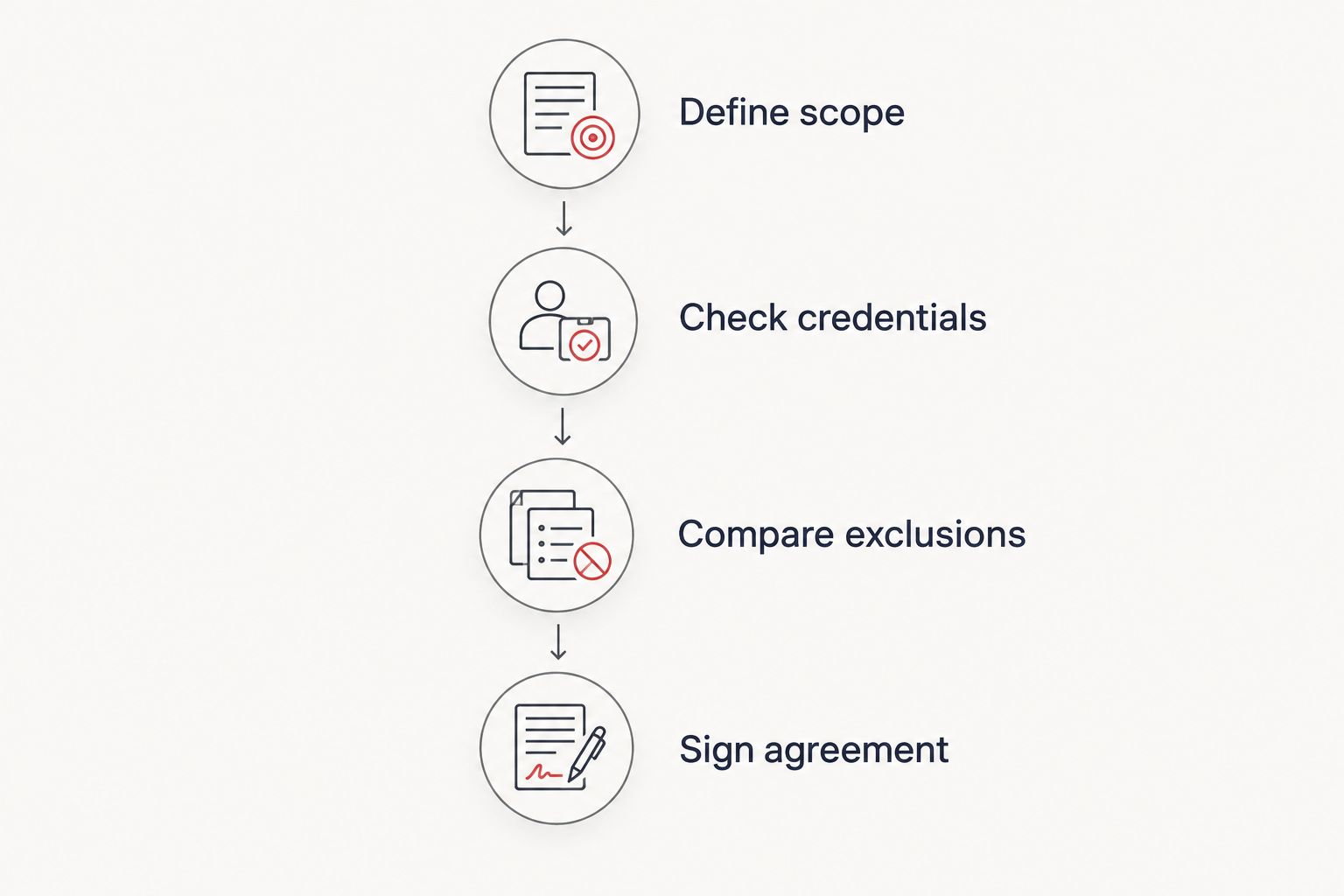
Both hiring routes end at this same checkpoint. The useful comparison is between documented proposals from actual contractors, not between the appearance of their search results.
Pricing: compare project estimates, not platform labels
Construction requires a project-specific estimate. Your building, site conditions, materials and finish requirements define the work being quoted; the hiring channel does not replace those details.
With a direct contractor, request an estimate for the agreed scope. With Angi, obtain estimates from the providers you are considering. Keep any platform-related terms separate from the construction agreement, and confirm who is charging for which service before accepting an arrangement.
For budgeting, separate 2 scopes: the work included in the construction agreement and the work you must arrange outside it. Ask specifically about design documents, permits, utility connections, site work, interior finishes and cleanup. These are items to clarify, not assumed exclusions.
Also distinguish a fixed specification from an allowance. If an estimate leaves a material selection unresolved, ask how the final selection changes the agreement. Predictability comes from defined scope and written change procedures, not from choosing direct hiring over a marketplace.
For 2026 estimate comparisons, give each contractor the same written project brief. Record differences before discussing the bottom line. Otherwise, the apparently simpler proposal can leave you responsible for work the other proposal already includes.
Final verdict: hire directly or build a shortlist
Choose Ayres Construction & Remodeling for direct local construction
Best for: a property owner in Kentucky or southern Indiana planning a new home, finished barndominium or another defined construction project who wants to speak directly with a local, licensed and insured general contractor.
This is the clearer route when you are ready to discuss site preparation through finished interiors. Bring the property location, intended use, available drawings and finish expectations to the estimate discussion. Request a written scope rather than assuming that a service description includes every project expense.
Choose Angi to find contractor candidates
Best for: a property owner who has not chosen a contractor shortlist and wants to explore service providers before requesting comparable proposals.
Use Angi for discovery, then evaluate the businesses that would actually perform the work. Ask each candidate the same scope, credential and contract questions. The platform helps with finding options; your selection still requires a contractor-level decision.
| Dimension | Winner |
|---|---|
| Direct local construction inquiry | Direct contractor |
| Finding multiple provider candidates | Angi |
| Clearly identified construction relationship | Direct contractor |
| Starting an integrated site-work discussion | Direct contractor |
| Scope and credential verification | Tie: required through either route |
| Budget predictability | Tie: depends on the written proposal |
FAQ
Is Ayres Contracting better than Angi for a new home?
Ayres Construction & Remodeling is the direct-hire choice for a new-home project in its Kentucky and southern Indiana service area. Angi is the marketplace choice when you need to find contractor candidates before deciding whom to hire.
Does Angi build the house or pole barn itself?
Angi is a service-provider marketplace, not the local construction company being compared here. Identify the contractor that would sign the agreement and perform or manage your work.
Can I request full barndominium construction instead of just a shell?
The direct contractor's barndominium service covers full construction from site preparation through finished interiors. Ask for a written scope that identifies materials, trade work, allowances and exclusions for your specific project.
Should I compare several estimates for a pole-barn garage?
Compare estimates only after giving each contractor the same intended use and written scope. Check whether site preparation, concrete, the building enclosure and interior work are included before comparing totals.
What should I check before hiring a contractor through Angi?
Check the selected contractor's applicable license documentation, current insurance documentation and proposed scope. Confirm that the business named in the agreement matches the business whose qualifications you reviewed.
How do I get an accurate construction estimate in 2026?
Provide the property location, intended building use, available plans and finish expectations. Ask the contractor to separate included work, allowances and exclusions so you can identify expenses outside the agreement.
One last thing
Ask every bidder to describe what you will be able to do with the building when its contracted work is complete. A weather-enclosed shell, a usable workshop and finished living space are different deliverables.
Request an estimate that names the finished condition you need. That single clarification makes a contractor comparison more useful than choosing by a marketplace name or a general service list.